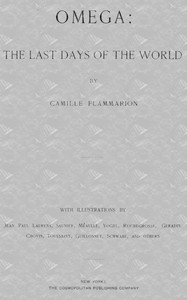
Omega: The Last Days of the World
by Camille Flammarion (1842-1925)
first published 1894 · free to read
length
55,924 words
a few pages a day
~8 min
finished in
30 days
full read
3h 53m
At Folio's default of ten pages a day, you finish Omega: The Last Days of the World in about 30 days — roughly 8 minutes of reading each morning.
The opening
the first pages of Omega: The Last Days of the World, free
The magnificent marble bridge which unites the Rue de Rennes with the Rue de Louvre, and which, lined with the statues of celebrated scientists and philosophers, emphasizes the monumental avenue leading to the new portico of the Institute, was absolutely black with people. A heaving crowd surged, rather than walked, along the quays, flowing out from every street and pressing forward toward the portico, long before invaded by a tumultuous throng. Never, in that barbarous age preceding the constitution of the United States of Europe, when might was greater than right, when military despotism ruled the world and foolish humanity quivered in the relentless grasp of war—never before in the stormy period of a great revolution, or in those feverish days which accompanied a declaration of war, had the approaches of the house of the people’s representatives, or the Place de la Concorde presented such a spectacle. It was no longer the case of a band of fanatics rallied about a flag, marching to some conquest of the sword, and followed by a throng of the curious and the idle, eager to see what would happen; but of the entire population, anxious, agitated, terrified, composed of every class of society without distinction, hanging upon the decision of an oracle, waiting feverishly the result of the calculations which a celebrated astronomer was to announce that very Monday, at three o’clock, in the session of the Academy of Sciences. Amid the flux of politics and society the Institute survived, maintaining still in Europe its supremacy in science, literature and art. The center of civilization, however, had moved westward, and the focus of progress shone on the shores of Lake Michigan, in North America.
This new palace of the Institute, with its lofty domes and terraces, had been erected upon the ruins remaining after the great social revolution of the international anarchists who, in 1950, had blown up the greater portion of the metropolis as from the vent of a crater.
[Illustration:
THE STREETS OF PARIS BY NIGHT ]
On the Sunday evening before, one might have seen from the car of a balloon all Paris abroad upon the boulevards and public squares, circulating slowly and as if in despair, without interest in anything. The gay aerial ships no longer cleaved the air; aeroplanes and aviators had all ceased to circulate. The aerial stations upon the summits of the towers and buildings were empty and deserted. The course of human life seemed arrested, and anxiety was depicted upon every face. Strangers addressed each other without hesitation; and but one question fell from pale and trembling lips: “Is it then true?” The most deadly pestilence would have carried far less terror to the heart than the astronomical prediction on every tongue; it would have made fewer victims, for already, from some unknown cause, the death-rate was increasing. At every instant one felt the electric shock of a terrible fear.
A few, less dismayed, wished to appear more confident, and sounded now and then a note of doubt, even of hope, as: “It may prove a mistake;” or, “It will pass on one side;” or, again: “It will amount to nothing; we shall get off with a fright,” and other like assurances.
But expectation and uncertainty are often more terrible than the catastrophe itself. A brutal blow knocks us down once for all, prostrating us more or less completely. We come to our senses, we make the best of it, we recover, and take up life again. But this was the unknown, the expectation of something inevitable but mysterious, terrible, coming from without the range of experience. One was to die, without doubt, but how? By the sudden shock of collision, crushed to death? By fire, the conflagration of a world? By suffocation, the poisoning of the atmosphere? What torture awaited humanity? Apprehension was perhaps more frightful than the reality itself. The mind cannot suffer beyond a certain limit. To suffer by inches, to ask every evening what the morning may bring, is to suffer a thousand deaths. Terror, that terror which congeals the blood in the veins, which annihilates the courage, haunted the shuddering soul like an invisible spectre.
Keep going from exactly here — Folio remembers your place and serves the next portion tomorrow.
continue reading Omega: The Last Days of the WorldAbout this free edition
Omega: The Last Days of the World by Camille Flammarion (1842-1925) is free to read in full. Folio serves it in daily portions you can actually finish, tracks your streak and reading position across devices, and reads every page aloud with a built-in narrator. The text comes from Project Gutenberg.