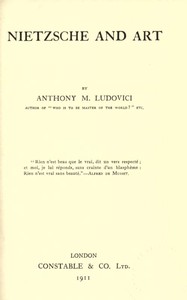
length
65,985 words
a few pages a day
~8 min
finished in
35 days
full read
4h 35m
At Folio's default of ten pages a day, you finish Nietzsche and Art in about 35 days — roughly 8 minutes of reading each morning.
The opening
the first pages of Nietzsche and Art, free
In this book, which embodies a course of lectures delivered in a somewhat condensed and summarized form at University College, London, during November and December, 1910, I have done two things. I have propounded Nietzsche's general Art doctrine, and, with the view of illustrating it and of defining it further, I have also applied its leading principles to one of the main branches of Art.
As this has not been done before, either in English or in any Continental language, my book is certainly not free from the crudeness and inadvertences which are inseparable from pioneer efforts of this nature. Nevertheless it is with complete confidence, and a deep conviction of its necessity, that I now see it go to print; for, even if here and there its adventurous spirit may ultimately require modification, I feel certain that, in the main, time itself, together with the help of other writers, will fully confirm its general thesis, if I should be unable to do so.
Sooner or later it will be brought home to us in Europe that we cannot with impunity foster and cultivate vulgarity and mob qualities in our architecture, our sculpture, our painting, our music and literature, without paying very dearly for these luxuries in our respective national politics, in our family institutions, and even in our physique. To connect all these things together, and to show their inevitable interdependence, would be a perfectly possible though arduous undertaking. In any case, this is not quite the task I have set myself in this work. I have indeed shown that to bestow admiration on a work of extreme democratic painting and at the same time to be convinced of the value of an aristocratic order of society, is to be guilty of a confusion of ideas which ultimately can lead only to disastrous results in practical life; but further than this I have not gone, simply because the compass of these lectures did not permit of my so doing.
Confining myself strictly to Nietzsche's æsthetic, I have been content merely to show that the highest Art, or Ruler Art, and therefore the highest beauty,--in which culture is opposed to natural rudeness, selection to natural chaos, and simplicity to natural complexity,--can be the flower and product only of an aristocratic society which, in its traditions and its active life, has observed, and continues to observe, the three aristocratic principles,--culture, selection and simplicity.
Following Nietzsche closely, I have sought to demonstrate the difference between the art which comes of inner poverty (realism, or democratic art), and that which is the result of inner riches (Ruler Art).
Identifying the first with the reflex actions which respond to external stimuli, I have shown it to be slavishly dependent upon environment for its existence, and, on that account, either beneath reality (Incompetence), on a level with reality (Realism), or fantastically different from reality (Romanticism). I have, moreover, associated these three forms of inferior art with democracy, because in democracy I find three conditions which are conducive to their cultivation, viz.--(1) The right of self-assertion granted to everybody, and the consequent necessary deterioration of world-interpretations owing to the fact that the function of interpretation is claimed by mediocrity; (2) the belief in a general truth that can be made common to all, which seems to become prevalent in democratic times, and which perforce reduces us to the only truth that can be made common to all, namely Reality; and (3) a democratic dislike of recognizing the mark or stamp of any particular human power in the things interpreted, and man's consequent "return to Nature" untouched by man, which, once again, is Reality.
Identifying Ruler Art, or the Art of inner riches, with the function of giving, I have shown it to be dependent upon four conditions which are quite inseparable from an aristocratic society, and which I therefore associate, without any hesitation, as Nietzsche does, with Higher Man, with Nature's rare and lucky strokes among men. These conditions are --(1) Long tradition under the sway of noble and inviolable values, resulting in an accumulation of will power and a superabundance of good spirits; (2) leisure which allows of meditation, and therefore of that process of lowering pitchers into the wells of inner riches; (3) the disbelief in freedom for freedom's sake without a purpose or without an aim; and (4) an order of rank according to which each is given a place in keeping with his value, and authority and reverence are upheld.
In the course of this exposition, it will be seen that I have to lay realism also at the door of Ruler Art; but I am careful to point out that, although such realism (I call it militant realism in respect to the art both of the Middle Ages and of the later Renaissance, as well as of Greece) is a fault, of Ruler Art which very much reduces the latter's rank among the arts; it is nevertheless above that other realism of mediocrity which, for the want of a better term, I call poverty realism. (See Lecture II, Part II, end.)
Keep going from exactly here — Folio remembers your place and serves the next portion tomorrow.
continue reading Nietzsche and ArtAbout this free edition
Nietzsche and Art by Anthony M. Ludovici (1882-1971) is free to read in full. Folio serves it in daily portions you can actually finish, tracks your streak and reading position across devices, and reads every page aloud with a built-in narrator. The text comes from Project Gutenberg.
More like Nietzsche and Art

Lysistrata
Anthony M. Ludovici
Woman
Anthony M. Ludovici
Meditations
Folio
Meditations
Marcus Aurelius
The Enchiridion
Epictetus
Thus Spake Zarathustra
Friedrich Nietzsche
Beyond Good and Evil
Folio
Beyond Good and Evil
Friedrich Nietzsche
The Genealogy of Morals
Folio
The Genealogy of Morals
Friedrich Nietzsche
The Republic
Folio
The Republic
Plato