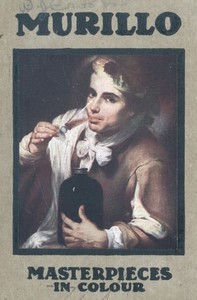
length
8,737 words
a few pages a day
~8 min
finished in
5 days
full read
36 min
At Folio's default of ten pages a day, you finish Murillo in about 5 days — roughly 8 minutes of reading each morning.
The opening
the first pages of Murillo, free
There have been long years in which the name of Bartolomé Esteban, known to the world as Murillo, was one to conjure with. Velazquez, El Greco, Ribera, Zurburan, Goya, were long uncertain in their appeal, recognised only by the enlightened among their contemporaries and ignored by the great majority of their fellow-countrymen. The pendulum of taste swings slowly from one extreme to the other, and, as the moods and needs of men change so they cast their idols into the dust, where they remain until another generation restores what it can find to the old pedestals. Nowadays Murillo has fallen from his high estate among the elect; they prefer to magnify his shortcomings rather than to acknowledge his many merits, to ignore the splendid service he rendered to Spanish art and the profound effect of his pictures in drawing countless simple souls within the sheltering folds of the Church. The fifty years of his devoted labours count for nothing, the self-searching and criticism that enabled the painter to move from a low plane to a high one are forgotten. This is not as it should be. Bartolomé Esteban Murillo had his limitations, but remains, despite them all, one of the world's teachers, and such glimpses of his life as may be seen through the shadows of some two hundred and fifty years reveal him as a serious artist who added to splendid natural gifts a steadfastness of purpose, a determination to do his best, a love of Andalusia, and a devotion to the religion in which he was brought up that must compel the admiration of thinking men however critical, and enable the artist to stand alone. In the early years of his sojourn he suffered from the pinch of poverty. He was born when Diego de Silva Velazquez was just about to enter upon his splendid career, in fact, Murillo would have been about five years old when his great contemporary left Seville for Madrid. Perhaps if we could see with understanding eyes we might be tempted to believe that the less distinguished artist enjoyed the happier life, for Velazquez in the court of kings had much to endure that never troubled the younger man who laboured in the service of the King of kings, and may have seen such visions as lightened the labours of Beato Angelico in the Convent of the Dominicans of St. Anthony in Padua, and St. Francis in Assisi. For the best of Murillo's canvases whisper to us of inspiration, of devout belief, and of an overmastering love for the "Maria santissima," and when the simple-hearted painter saw that his work brought honour to the cathedrals and convents for which he laboured he must have felt that his art was its own exceeding great reward.
======================================================================
PLATE II.--THE BEGGAR GIRL
(From the Dulwich Gallery)
We should prefer to call this picture the Flower-seller, for the girl is not really a beggar at all. Her clothes are worn with some approach to nicety, and she carries roses that command a ready sale in Seville if the seller be attractive and young. Murillo has given us a very charming type of Spanish girl, and has obtained some striking colour harmonies.
[Illustration: Plate II.--THE BEGGAR GIRL]
======================================================================
To this day Andalusia is a country of dreamers, and Seville, despite its electric trams and motor cars, its barracks and cosmopolitan hostelries, is par excellence the city of dreams. How much more so then, three hundred years ago, when Murillo was born to enjoy its beauty? In Seville wealth is a mere accident, even the poor may return thanks without mental reservation for the nugatory gift of life. Faith flourishes to-day in the agnostic generation as of old time, blended with what we would regard as superstition, but sharing this fault with all the Latin countries. In the Cathedral and the Caridad, to say nothing of smaller religious houses, the pictures of Murillo still remind us that to the Catholic religion the world owes the worship of a woman. To Murillo, God and the Virgin were not pale abstractions; they were his father and his mother, for he was hardly more than ten years old when his earthly parents fell victims to one of the epidemics so common in Europe in days when sanitation and isolation were not understood.
For twenty years, the most impressionable of his life, Murillo lived alone. Those who sneer at his work in these early times ignore the conditions under which it was done, forget that the cost of canvas and pigment was a very serious item in his exchequer, and that his reward was of the smallest. Wealth never came his way until he was no longer quite young, but as his circumstances became easier he did all that in him lay to express his message more completely and, while his labour was unremitting, his last work was his best, and included masterpieces that may hold their own in any company, even though it include the masters before whom artist and layman bow the head. Murillo has been cheapened by forgers and copyists who have succeeded in placing many of his shortcomings and very little of his quality on their hurried canvases. Every picture dealer in a Spanish city of any pretensions has a Murillo or two that he is prepared to vouch for even though the canvas gives the lie to his protestations. The artist's work has been used shamelessly for purposes of advertisement, it has paid the fullest penalties of popularity, and yet, a real Murillo in the best manner is a picture to which we can turn again and again, to find over and above the conquest of technical difficulties and the beauties of colour the qualities of imagination and inspiration that are associated with the select few in every branch of creative work. One might go as far as to say that Seville would lose as much as Madrid if the Murillos were taken from the one and the Velazquez pictures from the other. There would be no hesitation on the writer's part to say as much if the capital of Andalusia had never been rifled of its proper store by the French conquerors of Spain. It is not in foreign galleries that one must go to see the work of a great artist, but in the city that was his home--the city wherein the sources of his inspiration linger and his pictures find an appropriate setting. Transplanting is not good for anything. The trees and flowers, the birds and beasts of a foreign land may endure in a clime for which they were not intended, but there is no more than an arrested growth; they cannot do justice to themselves. Frankly and without reserve we admit that Murillo was almost as much an Andalusian as a painter, but when we know his city and his work there, a fine picture in the National Gallery or the Louvre will bring Seville back to us as surely as a sea-shell brings back the ceaseless murmur of the waves.
Keep going from exactly here — Folio remembers your place and serves the next portion tomorrow.
continue reading MurilloAbout this free edition
Murillo by S. L. Bensusan (1872-1958) is free to read in full. Folio serves it in daily portions you can actually finish, tracks your streak and reading position across devices, and reads every page aloud with a built-in narrator. The text comes from Project Gutenberg.
More like Murillo
Velazquez
S. L. Bensusan

Coleridge
S. L. Bensusan
Reynolds
S. L. Bensusan
Rubens
S. L. Bensusan

The Autobiography of Benjamin Franklin
Benjamin Franklin
Narrative of the Life of Frederick Douglass
Folio
Narrative of the Life of Frederick Douglass
Frederick Douglass
My Bondage and My Freedom
Folio
My Bondage and My Freedom
Frederick Douglass
The Story of My Life
Folio
The Story of My Life
Helen Keller