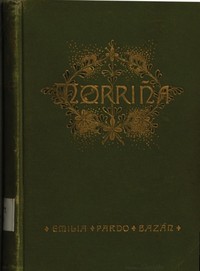
length
47,132 words
a few pages a day
~8 min
finished in
25 days
full read
3h 16m
At Folio's default of ten pages a day, you finish Morriña (Homesickness) in about 25 days — roughly 8 minutes of reading each morning.
The opening
the first pages of Morriña (Homesickness), free
If the apartment which Doña Nogueira de Pardiñas and her only son Rogelio occupied in Madrid was neither the sunniest nor the most spacious to be found in the city, it possessed, on the other hand, the inestimable advantage of being situated in the Calle Ancha de San Bernardo, so close to the Central University that to live in it was, as one might say, the same as living in the university itself.
Seated in her leather-covered easy-chair by the window, widening and narrowing the stocking she was
[Illustration: “Seated in her leather-covered easy-chair by the window.”]
knitting without once looking at it, Señora de Pardiñas would follow her adored boy with her gaze, which, traversing space and passing through the solid substance of the walls, accompanied him to the very lecture-room of the university. She saw him when he went in and when he came out--she noticed whether he stopped to chat with any one, whom he talked to, whether he laughed; she knew who his companions were, whom he liked and whom he disliked; who were the industrious students and whom the idle ones; who were regular and who were irregular in their attendance. She was familiar, too, with the faces of the professors, and made a study of their expression and their manner of returning the salutations of the pupils, drawing from external signs important psychological deductions bearing on the problem of the examinations: “Ah, there comes old Contreras already, the Professor of Procedure. How amiable he looks! what a saint-like face he has. How slowly he walks, poor man. ’Tis easy to see that he suffers from rheumatism as I do. The more’s the pity! I like him on that account, and not on that account alone, but because I know that he is indulgent and that he will give Rogelio a good mark in his examination. Now comes Ruiz del Monte, so stiff and so conceited. He looks as if he were made all in one piece. Poor us! Neither favor nor influence nor anything else is of any use with him. He would have the boys know the studies as well as he does himself. If he wants that let him give them his place in the college--and the pay as well. Ah, here we have Señor de Lastra. He stoops a little. What comical caricatures the boys make of him in the class! And he is familiar to a fault. There he is now clapping Benito Diaz, Rogelio’s great friend, on the back. He looks to me like a good easy-going man. My blessing upon him! I don’t know what there is to be gained by torturing poor boys and distressing their parents.”
Pausing in her soliloquy, the good lady ran her knitting needle through the coil of her hair, now turning gray, and scratched her head lightly with it. Suddenly her withered cheek flushed brightly as if a breath of youth had blown across it.
“Ah, there is Rogelio,” she cried.
The student emerged from the building, wrapped in his crimson plush cloak, his low, broad-brimmed hat slightly tipped to one side, his glance fixed, from the first moment, on the window at which his mother was sitting. Generally he would give her a smile, but sometimes, assuming a serious air, he would raise his hand to his hat, and, with the stiff movement of a marionette, mimic the salutation of the dandies of the Retiro. The mother would return his salutation, shaking her hand threateningly at him, convulsed with laughter, as if this were not a jest of almost daily repetition. Then the boy would stop to chat for a few minutes with some of his fellow-students; he would exchange a word in passing with the match-vender, the ticket-vender, the orange-girl at the corner, and the clerks of the neighboring shops, winding up with some half-jesting compliment to the servants who stood chatting at the doors; and finally he would ascend the steps of his own house, where Doña Aurora was already waiting for him in the hall. His first words were generally in the following strain:
Keep going from exactly here — Folio remembers your place and serves the next portion tomorrow.
continue reading Morriña (Homesickness)About this free edition
Morriña (Homesickness) by Emilia condesa de Pardo Bazán (1852-1921) is free to read in full. Folio serves it in daily portions you can actually finish, tracks your streak and reading position across devices, and reads every page aloud with a built-in narrator. The text comes from Project Gutenberg.
More like Morriña (Homesickness)
Pride and Prejudice
Jane Austen

Sense and Sensibility
Jane Austen
Emma
Folio
Emma
Jane Austen
Persuasion
Folio
Persuasion
Jane Austen
Mansfield Park
Folio
Mansfield Park
Jane Austen
Jane Eyre
Charlotte Brontë
The Tenant of Wildfell Hall
Folio
The Tenant of Wildfell Hall
Anne Brontë
Agnes Grey
Folio
Agnes Grey
Anne Brontë