Montezuma's Daughter
Folio
length
150,831 words
a few pages a day
~8 min
finished in
80 days
full read
10h 28m
At Folio's default of ten pages a day, you finish Montezuma's Daughter in about 80 days — roughly 8 minutes of reading each morning.
The opening
the first pages of Montezuma's Daughter, free
Strange as were the adventures and escapes of Thomas Wingfield, once of this parish, whereof these pages tell, your own can almost equal them in these latter days, and, since a fellow feeling makes us kind, you at least they may move to a sigh of sympathy. Among many a distant land you know that in which he loved and fought, following vengeance and his fate, and by your side I saw its relics and its peoples, its volcans and its valleys. You know even where lies the treasure which, three centuries and more ago, he helped to bury, the countless treasure that an evil fortune held us back from seeking. Now the Indians have taken back their secret, and though many may search, none will lift the graven stone that seals it, nor shall the light of day shine again upon the golden head of Montezuma. So be it! The wealth which Cortes wept over, and his Spaniards sinned and died for, is for ever hidden yonder by the shores of the bitter lake whose waters gave up to you that ancient horror, the veritable and sleepless god of Sacrifice, of whom I would not rob you—and, for my part, I do not regret the loss.
What cannot be lost, what to me seem of more worth than the dead hero Guatemoc’s gems and jars of gold, are the memories of true friendship shown to us far away beneath the shadow of the Slumbering Woman,[1] and it is in gratitude for these that I ask permission to set your name within a book which were it not for you would never have been written.
I am, my dear Jebb, Always sincerely yours, H. RIDER HAGGARD.
DITCHINGHAM, NORFOLK, October 5, 1892. To J. Gladwyn Jebb, Esq.
NOTE
Worn out prematurely by a life of hardship and extraordinary adventure, Mr. Jebb passed away on March 18, 1893, taking with him the respect and affection of all who had the honour of his friendship. The author has learned with pleasure that the reading of this tale in proof and the fact of its dedication to himself afforded him some amusement and satisfaction in the intervals of his sufferings.
H. R. H.
March 22, 1893.
[1] The volcano Izticcihuatl in Mexico.
NOTE
The more unpronounceable of the Aztec names are shortened in many instances out of consideration for the patience of the reader; thus “Popocatapetl” becomes “Popo,” “Huitzelcoatl” becomes “Huitzel,” &c. The prayer in Chapter xxvi. is freely rendered from Jourdanet’s French translation of Fray Bernardino de Sahagun’s History of New Spain, written shortly after the conquest of Mexico (Book VI, chap. v.), to which monumental work and to Prescott’s admirable history the author of this romance is much indebted. The portents described as heralding the fall of the Aztec Empire, and many of the incidents and events written of in this story, such as the annual personation of the god Tezcatlipoca by a captive distinguished for his personal beauty, and destined to sacrifice, are in the main historical. The noble speech of the Emperor Guatemoc to the Prince of Tacuba uttered while they both were suffering beneath the hands of the Spaniards is also authentic.
Montezuma’s Daughter
CHAPTER I WHY THOMAS WINGFIELD TELLS HIS TALE
Now glory be to God who has given us the victory! It is true, the strength of Spain is shattered, her ships are sunk or fled, the sea has swallowed her soldiers and her sailors by hundreds and by thousands, and England breathes again. They came to conquer, to bring us to the torture and the stake—to do to us free Englishmen as Cortes did by the Indians of Anahuac. Our manhood to the slave bench, our daughters to dishonour, our souls to the loving-kindness of the priest, our wealth to the Emperor and the Pope! God has answered them with his winds, Drake has answered them with his guns. They are gone, and with them the glory of Spain.
I, Thomas Wingfield, heard the news to-day on this very Thursday in the Bungay market-place, whither I went to gossip and to sell the apples which these dreadful gales have left me, as they hang upon my trees.
Before there had been rumours of this and of that, but here in Bungay was a man named Young, of the Youngs of Yarmouth, who had served in one of the Yarmouth ships in the fight at Gravelines, aye and sailed north after the Spaniards till they were lost in the Scottish seas.
Keep going from exactly here — Folio remembers your place and serves the next portion tomorrow.
continue reading Montezuma's DaughterAbout this free edition
Montezuma's Daughter by H. Rider Haggard (1856-1925) is free to read in full. Folio serves it in daily portions you can actually finish, tracks your streak and reading position across devices, and reads every page aloud with a built-in narrator. The text comes from Project Gutenberg.
More like Montezuma's Daughter
Mr. Meeson's Will
Folio
Mr. Meeson's Will
H. Rider Haggard
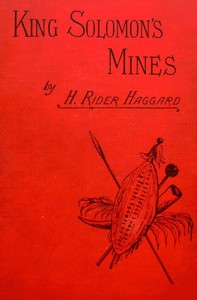
King Solomon's Mines
H. Rider Haggard
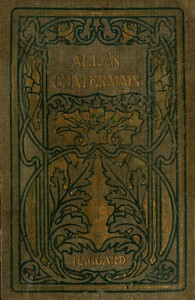
Allan Quatermain
H. Rider Haggard
She
Folio
She
H. Rider Haggard
Nada the Lily
Folio
Nada the Lily
H. Rider Haggard
Cleopatra
Folio
Cleopatra
H. Rider Haggard
Eric Brighteyes
Folio
Eric Brighteyes
H. Rider Haggard
Allan's Wife
Folio
Allan's Wife
H. Rider Haggard