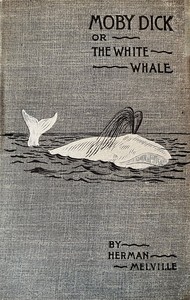
length
212,114 words
a few pages a day
~8 min
finished in
112 days
full read
14h 44m
At Folio's default of ten pages a day, you finish Moby Dick in about 112 days — roughly 8 minutes of reading each morning.
The opening
the first pages of Moby Dick, free
This text is a combination of etexts, one from the now-defunct ERIS project at Virginia Tech and one from Project Gutenberg’s archives. The proofreaders of this version are indebted to The University of Adelaide Library for preserving the Virginia Tech version. The resulting etext was compared with a public domain hard copy version of the text.
ETYMOLOGY.
(Supplied by a Late Consumptive Usher to a Grammar School.)
The pale Usher—threadbare in coat, heart, body, and brain; I see him now. He was ever dusting his old lexicons and grammars, with a queer handkerchief, mockingly embellished with all the gay flags of all the known nations of the world. He loved to dust his old grammars; it somehow mildly reminded him of his mortality.
“While you take in hand to school others, and to teach them by what name a whale-fish is to be called in our tongue, leaving out, through ignorance, the letter H, which almost alone maketh up the signification of the word, you deliver that which is not true.” —Hackluyt.
“WHALE. * * * Sw. and Dan. hval. This animal is named from roundness or rolling; for in Dan. hvalt is arched or vaulted.” —Webster’s Dictionary.
“WHALE. * * * It is more immediately from the Dut. and Ger. Wallen; A.S. Walw-ian, to roll, to wallow.” —Richardson’s Dictionary.
חו, Hebrew. ϰητος, Greek. CETUS, Latin. WHŒL, Anglo-Saxon. HVALT, Danish. WAL, Dutch. HWAL, Swedish. HVALUR, Icelandic. WHALE, English. BALEINE, French. BALLENA, Spanish. PEKEE-NUEE-NUEE, Fegee. PEHEE-NUEE-NUEE, Erromangoan.
EXTRACTS. (Supplied by a Sub-Sub-Librarian).
It will be seen that this mere painstaking burrower and grub-worm of a poor devil of a Sub-Sub appears to have gone through the long Vaticans and street-stalls of the earth, picking up whatever random allusions to whales he could anyways find in any book whatsoever, sacred or profane. Therefore you must not, in every case at least, take the higgledy-piggledy whale statements, however authentic, in these extracts, for veritable gospel cetology. Far from it. As touching the ancient authors generally, as well as the poets here appearing, these extracts are solely valuable or entertaining, as affording a glancing bird’s eye view of what has been promiscuously said, thought, fancied, and sung of Leviathan, by many nations and generations, including our own.
So fare thee well, poor devil of a Sub-Sub, whose commentator I am. Thou belongest to that hopeless, sallow tribe which no wine of this world will ever warm; and for whom even Pale Sherry would be too rosy-strong; but with whom one sometimes loves to sit, and feel poor-devilish, too; and grow convivial upon tears; and say to them bluntly, with full eyes and empty glasses, and in not altogether unpleasant sadness—Give it up, Sub-Subs! For by how much the more pains ye take to please the world, by so much the more shall ye for ever go thankless! Would that I could clear out Hampton Court and the Tuileries for ye! But gulp down your tears and hie aloft to the royal-mast with your hearts; for your friends who have gone before are clearing out the seven-storied heavens, and making refugees of long-pampered Gabriel, Michael, and Raphael, against your coming. Here ye strike but splintered hearts together—there, ye shall strike unsplinterable glasses!
EXTRACTS.
“And God created great whales.” —Genesis.
“Leviathan maketh a path to shine after him; One would think the deep to be hoary.” —Job.
“Now the Lord had prepared a great fish to swallow up Jonah.” —Jonah.
Keep going from exactly here — Folio remembers your place and serves the next portion tomorrow.
continue reading Moby DickAbout this free edition
Moby Dick by Herman Melville (1819-1891) is free to read in full. Folio serves it in daily portions you can actually finish, tracks your streak and reading position across devices, and reads every page aloud with a built-in narrator. The text comes from Project Gutenberg.
More like Moby Dick
Typee: A Romance of the South Seas
Folio
Typee: A Romance of the South Seas
Herman Melville
Redburn. His First Voyage
Folio
Redburn. His First Voyage
Herman Melville
Treasure Island
Robert Louis Stevenson

Kidnapped
Robert Louis Stevenson

The Call of the Wild
Jack London
White Fang
Jack London
The Sea-Wolf
Jack London
The Count of Monte Cristo
Alexandre Dumas