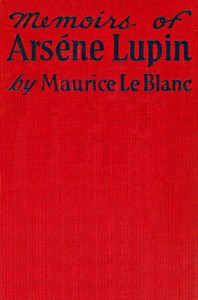
length
83,713 words
a few pages a day
~8 min
finished in
45 days
full read
5h 49m
At Folio's default of ten pages a day, you finish Memoirs of Arsène Lupin in about 45 days — roughly 8 minutes of reading each morning.
The opening
the first pages of Memoirs of Arsène Lupin, free
This is the story of the first adventure of Arsène Lupin, and undoubtedly it would have been published before the stories of the others if he had not so often and so resolutely opposed it.
“No,” he would say, “there are one or two little matters yet to be settled between the Countess of Cagliostro and me. We must wait.”
The waiting lasted longer than he foresaw. More than a quarter of a century passed before the final settlement; and only to-day am I permitted to relate the frightful duel of love and hate which brought a boy of twenty to grips with Cagliostro’s daughter.
CONTENTS
CHAPTER PAGE
I ARSÈNE LUPIN AT TWENTY 11
II JOSEPHINE BALSAMO BORN IN 1788 30
III A TRIBUNAL OF THE INQUISITION 46
IV THE SINKING BOAT 66
V ONE OF THE SEVEN BRANCHES 84
VI DETECTIVES AND POLICEMEN 102
VII THE DELIGHTS OF CAPUA 123
VIII TWO WILLS 143
IX THE TARPEIAN ROCK 166
X THE MUTILATED HAND 189
XI THE OLD LIGHTHOUSE 209
XII MADNESS AND GENIUS 229
XIII THE STRONG-BOX OF THE MONKS 259
XIV THE INFERNAL CREATURE 282
EPILOGUE 312
MEMOIRS OF ARSÈNE LUPIN
MEMOIRS OF ARSÈNE LUPIN
CHAPTER I.
ARSÈNE LUPIN AT TWENTY
Ralph d’Andresy extinguished the lamp, and thrust his bicycle behind a bank. At that moment the clock of Benouville struck three.
In the deep shadow of the night he followed the lane which led to the estate of La Haie d’Etigues and so came to the wall which ran round it. He waited a little--the sound of horses pawing the ground, of wheels which rang on the pavement of the court-yard, the sound of harness bells. Then the two leaves of the big door were thrown open and a carriage passed out. It passed so quickly that Ralph barely caught the sound of men’s voices and perceived the barrel of a gun before the vehicle reached the high road and took the way to Etretat.
“Come,” said he. “Shooting gulls is an attractive sport and the rock where they shoot them is a long way off. At last I’m going to know the meaning of this improvised shooting-party and of all these odd comings and goings.”
He took his way along the boundary wall to the left, turned a corner and then another, and stopped forty yards along the wall. In his hand he held two keys. The first of them opened a small, low door. He went through it up a staircase hollowed out of the wall, half fallen to ruin, which, running along its left wing, had formed one of the old defences of the château. The second key opened for him a secret door in the first floor of the château itself.
He lit a small bull’s-eye lantern and without taking any special precautions, since he knew that the staff of servants lived in the other wing and that Clarice d’Etigues, the only daughter of the Baron, had her rooms on the second floor, went down a passage which brought him to a large study. In that very room some weeks previously he had asked the Baron for his daughter’s hand in marriage. His proposal had been received with an explosion of indignant anger of which he retained a most disagreeable recollection.
A mirror showed him the pale face of a young man, even paler than usual. However, inured to emotion, he remained master of himself and coolly addressed himself to his task.
He was not long about it. In the course of his interview with the Baron he had observed that that gentleman now and then cast a glance at a large mahogany roll-top desk of which the top had not been drawn down. Ralph knew all the places in which it is possible to put a secret drawer and all the mechanical devices that work such secret drawers. In a very short time he discovered in a cranny of the desk a tiny drawer which held a letter written on very thin paper and rolled up into the shape of a cigarette. No signature. No address.
Keep going from exactly here — Folio remembers your place and serves the next portion tomorrow.
continue reading Memoirs of Arsène LupinAbout this free edition
Memoirs of Arsène Lupin by Maurice Leblanc (1864-1941) is free to read in full. Folio serves it in daily portions you can actually finish, tracks your streak and reading position across devices, and reads every page aloud with a built-in narrator. The text comes from Project Gutenberg.
More like Memoirs of Arsène Lupin
The Extraordinary Adventures of Arsène Lupin, Gentleman-Burglar
Folio
The Extraordinary Adventures of Arsène Lupin, Gentleman-Burglar
Maurice Leblanc
The Hollow Needle
Folio
The Hollow Needle
Maurice Leblanc
813
Folio
813
Maurice Leblanc
Arsène Lupin
Maurice Leblanc
The Confessions of Arsène Lupin
Maurice Leblanc
The Eight Strokes of the Clock
Folio
The Eight Strokes of the Clock
Maurice Leblanc
Arsène Lupin versus Herlock Sholmes
Folio
Arsène Lupin versus Herlock Sholmes
Maurice Leblanc
The Golden Triangle
Folio
The Golden Triangle
Maurice Leblanc