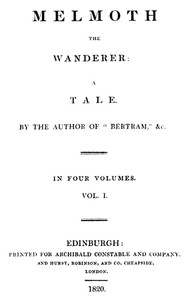
length
56,493 words
a few pages a day
~8 min
finished in
30 days
full read
3h 55m
At Folio's default of ten pages a day, you finish Melmoth the Wanderer in about 30 days — roughly 8 minutes of reading each morning.
The opening
the first pages of Melmoth the Wanderer, free
The hint of this Romance (or Tale) was taken from a passage in one of my Sermons, which (as it is to be presumed very few have read) I shall here take the liberty to quote. The passage is this.
“At this moment is there one of us present, however we may have departed from the Lord, disobeyed his will, and disregarded his word--is there one of us who would, at this moment, accept all that man could bestow, or earth afford, to resign the hope of his salvation?--No, there is not one--not such a fool on earth, were the enemy of mankind to traverse it with the offer!”
This passage suggested the idea of “Melmoth the Wanderer.” The Reader will find that idea developed in the following pages, with what power or success he is to decide.
The “Spaniard’s Tale” has been censured by a friend to whom I read it, as containing too much attempt at the revivification of the horrors of Radcliffe-Romance, of the persecutions of convents, and the terrors of the Inquisition.
I defended myself, by trying to point out to my friend, that I had made the misery of conventual life depend less on the startling adventures one meets with in romances, than on that irritating series of petty torments which constitutes the misery of life in general, and which, amid the tideless stagnation of monastic existence, solitude gives its inmates leisure to invent, and power combined with malignity, the full disposition to practise. I trust this defence will operate more on the conviction of the Reader, than it did on that of my friend.
For the rest of the Romance, there are some parts of it which I have borrowed from real life.
The story of John Sandal and Elinor Mortimer is founded in fact.
The original from which the Wife of Walberg is imperfectly sketched is a living woman, and long may she live.
I cannot again appear before the public in so unseemly a character as that of a writer of romances, without regretting the necessity that compels me to it. Did my profession furnish me with the means of subsistence, I should hold myself culpable indeed in having recourse to any other, but--am I allowed the choice?
Dublin, } 31st August 1820. }
MELMOTH.
CHAPTER I.
Alive again? Then show me where he is; I’ll give a thousand pounds to look upon him.
SHAKESPEARE.
In the autumn of 1816, John Melmoth, a student in Trinity College, Dublin, quitted it to attend a dying uncle on whom his hopes for independence chiefly rested. John was the orphan son of a younger brother, whose small property scarce could pay John’s college expences; but the uncle was rich, unmarried, and old; and John, from his infancy, had been brought up to look on him with that mingled sensation of awe, and of the wish, without the means to conciliate, (that sensation at once attractive and repulsive), with which we regard a being who (as nurse, domestic, and parent have tutored us to believe) holds the very threads of our existence in his hands, and may prolong or snap them when he pleases.
On receiving this summons, John set immediately out to attend his uncle.
The beauty of the country through which he travelled (it was the county Wicklow) could not prevent his mind from dwelling on many painful thoughts, some borrowed from the past, and more from the future. His uncle’s caprice and moroseness,--the strange reports concerning the cause of the secluded life he had led for many years,--his own dependent state,--fell like blows fast and heavy on his mind. He roused himself to repel them,--sat up in the mail, in which he was a solitary passenger,--looked out on the prospect,--consulted his watch;--then he thought they receded for a moment,--but there was nothing to fill their place, and he was forced to invite them back for company. When the mind is thus active in calling over invaders, no wonder the conquest is soon completed. As the carriage drew near the Lodge, (the name of old Melmoth’s seat), John’s heart grew heavier every moment.
Keep going from exactly here — Folio remembers your place and serves the next portion tomorrow.
continue reading Melmoth the WandererAbout this free edition
Melmoth the Wanderer by Charles Robert Maturin (1780-1824) is free to read in full. Folio serves it in daily portions you can actually finish, tracks your streak and reading position across devices, and reads every page aloud with a built-in narrator. The text comes from Project Gutenberg.
More like Melmoth the Wanderer
Dracula
Bram Stoker
The Strange Case of Dr. Jekyll and Mr. Hyde
Robert Louis Stevenson
The Turn of the Screw
Folio
The Turn of the Screw
Henry James

The Picture of Dorian Gray
Oscar Wilde
The Fall of the House of Usher
Folio
The Fall of the House of Usher
Edgar Allan Poe
Carmilla
Joseph Sheridan Le Fanu
Uncle Silas
Folio
Uncle Silas
Joseph Sheridan Le Fanu
The Castle of Otranto
Folio
The Castle of Otranto
Horace Walpole