length
5,168 words
a few pages a day
~8 min
finished in
3 days
full read
22 min
At Folio's default of ten pages a day, you finish Masters of Water-Colour Painting in about 3 days — roughly 8 minutes of reading each morning.
The opening
the first pages of Masters of Water-Colour Painting, free
Readers who cannot use the fully illustrated version of this file may like to view some individual pictures in the "images" directory associated with the HTML file. Each comes in two sizes.
This text file is for readers who cannot use the "real" (unicode, utf-8) version of the file. All fractions in Plate descriptions have been "unpacked" in the form 17-7/8.]
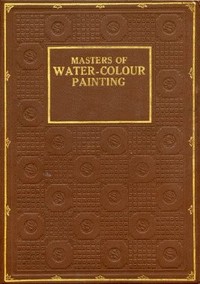
[Illustration: Cover]
MASTERS OF WATER-COLOUR PAINTING With Introduction by H. M. Cundall, I.S.O., F.S.A.
Edited By Geoffrey Holme London: The Studio, Ltd., 44 Leicester Square, W.C.2 1922-1923
CONTENTS Page
Introduction by H. M. Cundall, I.S.O., F.S.A. 1
ILLUSTRATIONS IN COLOURS Plate
Bonington, Richard Parkes Near Jumieges xxiv
Cotman, John Sell Classical Scene xiii
Cox, David Boys Fishing xviii
Cozens, John Robert Lake Nemi x
Dayes, Edward Furness Abbey, Lancashire vii
De Wint, Peter St. Albans xvi
Farington, R.A., Joseph Scotch Landscape v
Fielding, A. V. Copley Lake Scene xvii
Girtin, Thomas Landscape xi
Glover, John View in North Wales xv
Harding, James Duffield Vico, Bay of Naples xx
Hearne, Thomas View of Gloucester iv
Holland, James A Shrine in Venice xxii
Hunt, William Henry Plucking the Fowl xxi
Malton, Thomas, Jun. Old Palace Yard, Westminster vi
Prout, Samuel Palazzo Contarini Fasan on the Grand Canal, Venice xix
Pyne, James Baker View in Italy xxiii
Rooker, A.R.A., Michael (Angelo) Village Scene iii
Rowlandson, Thomas Entrance to Vauxhall Gardens ix
Sandby, R.A., Paul Windsor Castle: View of the Round and Devil's Towers from the Black Rock i
Towne, Francis On the Dart ii
Turner, R.A., J. M. W. Lucerne: Moonlight xii
Varley, John Hackney Church xiv
Wheatley, R.A., Francis Preparing for Market viii
The Editor desires to acknowledge his indebtedness to Mr. A. E. Hutton, Mr. R. W. Lloyd, Mr. Victor Rienaecker, Mr. G. Bellingham Smith and Messrs. Thos. Agnew & Sons who have kindly lent their drawings for reproduction in this volume.
INTRODUCTION
The earliest form of painting was with colours ground in water. Egyptian artists three thousand years B.C. used this method, and various mediums, such as wax and mastic, were added as a fixative. It was what is now known as tempera painting. The Greeks acquired their knowledge of the art from the Egyptians, and later the Romans dispersed it throughout Europe. They probably introduced tempera painting into this country for decoration of the walls of their houses. The English monks visited the Continent and learnt the art of miniature painting for illuminating their manuscripts by the same process. Owing to opaque white being mixed with the colours the term of painting in body-colour came in use. Painting in this manner was employed by artists throughout Europe in making sketches for their oil paintings.
Two such drawings by Albrecht Durer, produced with great freedom in the early part of the sixteenth century, are in the British Museum. The Dutch masters also employed the same means. Holbein introduced the painting of miniature portraits into this country, for although the monks inserted figures in their illuminations, little attempt was made in producing likenesses. As early as the middle of the seventeenth century the term "water colours" came into use. In an inventory, in manuscript, of the personal estate of Charles I, which was sold by an Act of Parliament, numerous pictures are thus described.
Keep going from exactly here — Folio remembers your place and serves the next portion tomorrow.
continue reading Masters of Water-Colour PaintingAbout this free edition
Masters of Water-Colour Painting by C. Geoffrey Holme (1887-1954) is free to read in full. Folio serves it in daily portions you can actually finish, tracks your streak and reading position across devices, and reads every page aloud with a built-in narrator. The text comes from Project Gutenberg.
More like Masters of Water-Colour Painting
The History of the Peloponnesian War
Folio
The History of the Peloponnesian War
Thucydides
The History of Herodotus
Folio
The History of Herodotus
Herodotus
The Gallic Wars
Folio
The Gallic Wars
Julius Caesar
Anabasis
Folio
Anabasis
Xenophon
The Lives of the Twelve Caesars
Folio
The Lives of the Twelve Caesars
Suetonius
Germania
Folio
Germania
Tacitus

The History of the Decline and Fall of the Roman Empire
Edward Gibbon
The Travels of Marco Polo
Marco Polo