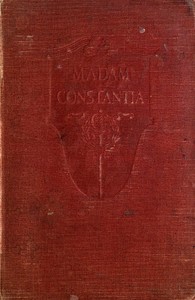
length
65,784 words
a few pages a day
~8 min
finished in
35 days
full read
4h 34m
At Folio's default of ten pages a day, you finish Madam Constantia in about 35 days — roughly 8 minutes of reading each morning.
The opening
the first pages of Madam Constantia, free
Although the Historical Manuscripts Commission (England) has dealt with several of the Northumberland Collections, the Commission has not thought fit to print among the papers of the Craven family of Osgodby, the narrative of the fifth baronet’s experiences in South Carolina during the War of American Independence. The reason for this decision may be either a belief that the episode is not of value from a historical standpoint; or a suspicion that the facts owe something to the expansion of a man writing many years later. However this may be, the story seemed to the present Editor to possess a certain poignancy, and, notwithstanding some intimate passages, to be worthy of a public wider than that of the County of its birth. He has, therefore, with such skill as he possesses prepared it for publication.
It will be noticed that Sir Edward Craven nowhere names the regiment in which he served, but it appears from other sources that it was the 33rd Regiment of Foot, now styled the Duke of Wellington’s Regiment.
The Editor has thought proper to retain the fanciful title prefixed by the writer, but has added some Chapter headings.
MADAM CONSTANTIA
CHAPTER I SIR EDWARD’S PREFACE
So here is this fatal war commenced! ‘The Child that is unborn shall rue The hunting of that day!’ H. WALPOLE.
Not Lord Chatham, not Alexander the Great, nor Cæsar has ever conquered so much territory in the course of all their wars as Lord North has lost in one campaign!
C. J. FOX.
Six months ago I went through the old papers in the Strongroom. I noted that neither my father nor my grandfather had added a line, save in the way of leases and the like, to the records which the first and second baronets left of the Siege of Newcastle, and of the Union troubles. It occurred to me that we owed something to posterity; and that, for lack of more important matter, my fortunes en campagne in America were a part of the family history, and proper to be preserved.
For an idle man, however, to will and to do are two things; and I might never have proceeded beyond the former if I had not a day or two later taken up the Gentleman’s Magazine and learned that General Washington of the United States of America had passed away at his seat at Mount Vernon on the fourteenth of the preceding month. That gave me the needed fillip. I never knew him; at least I never knew him by that title, since on the few occasions on which I met him, it was beyond my duty as an officer in His Majesty’s service to admit the existence of the States. I believe him, however, to have been a gentleman of good family, kindly and dignified, somewhat of the old school, and of considerable military ability; one, too, whose influence went some way towards checking within his sphere of action the rancour that in the Southern Colonies stained the Continental Cause and did not spare ours. Unfortunately from ’80 onwards my duty led me into the Carolinas; and it was to the sad and unusual nature of the war in those provinces that what was singular in my experiences was due.
Previously, to be brief, I had served for three years in the north, I had suffered the humiliation of surrendering with that gallant and loyal gentleman, General Burgoyne, I had been exchanged. But my experiences in Canada and on the Hudson were those of a hundred others and I pass over them, proposing to begin my relation at the point at which the fortunes of war cast me adrift, and flung me on my own resources.
From where I write, looking out on the barren, frost-bound hills of the Border, it is a far cry to the rice-fields and tropical lands of the Tidewater of Carolina; and a farther cry to the rolling country of pleasant vale and forest that sweeps upwards to the foothills, and so to the misty distances of the Blue Ridge. In those days it was often a three months’ passage, on salt meat and stale water; a passage of which many a poor fellow never saw the end. To-day I cross in a moment. But before I do so, let me add a word of preface, that all who read this may view the matter from our standpoint in ’80, midway in the fighting, rather than from the point at which we stand to-day, with the end behind us and an American Minister at St. James’s.
Keep going from exactly here — Folio remembers your place and serves the next portion tomorrow.
continue reading Madam ConstantiaAbout this free edition
Madam Constantia by Jefferson Carter is free to read in full. Folio serves it in daily portions you can actually finish, tracks your streak and reading position across devices, and reads every page aloud with a built-in narrator. The text comes from Project Gutenberg.
More like Madam Constantia
Pride and Prejudice
Jane Austen

Sense and Sensibility
Jane Austen
Emma
Folio
Emma
Jane Austen
Persuasion
Folio
Persuasion
Jane Austen
Mansfield Park
Folio
Mansfield Park
Jane Austen

Jane Eyre
Charlotte Brontë
The Tenant of Wildfell Hall
Folio
The Tenant of Wildfell Hall
Anne Brontë
Agnes Grey
Folio
Agnes Grey
Anne Brontë