length
98,405 words
a few pages a day
~8 min
finished in
52 days
full read
6h 50m
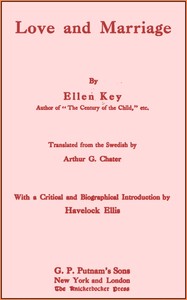
At Folio's default of ten pages a day, you finish Love and Marriage in about 52 days — roughly 8 minutes of reading each morning.
The opening
the first pages of Love and Marriage, free
In this treatise, the veteran Swedish reformer attacks problems the most vital to the welfare of the human race, problems which have throughout the centuries engaged the attention of leaders of thought.
The writers who have given attention to the complex subject of the relations of the sexes, of the obligations of the state in the control of these relations, and of the organisation of the family as the foundation of society, include such authors as Plato, Goethe, Richter, Rousseau, Mary Wollstonecraft, Fourier, Comte, Mrs. Browning, Mill, Ibsen, Westermarck, Charlotte Gilman, Havelock Ellis, and many others.
These problems are complex, and the difficulties presented by them most serious. No writer has ever yet presented solutions that could be accepted as finally satisfactory. Ellen Key writes with a profound antagonism to the philistinism and hypocrisy which have characterised much of the consideration given by the community to the subjects. She points out (as has, of course, been emphasised by many earlier writers) that the ignoring of an evil does not dispose of it, and that so far from preserving society from its influence, the burying of an evil merely tends to increase its corrupting and demoralising results.
Whether or not the reader be prepared to accept the conclusions and recommendations of the Swedish thinker, he must recognise that these conclusions represent the result of painstaking and scholarly thought and investigation. Daring and iconoclastic as they may be, the views of Ellen Key are presented with a calmness and philosophy of method that is absolutely free from any trace of sensationalism. The book, which is being distributed in half a dozen languages to a world’s public, must be accepted as a most important contribution to philosophic thought.
The introduction by Havelock Ellis, himself an authority on social problems, will help to make clear its purpose and character.
NEW YORK, January, 1911.
CONTENTS
PAGE
INTRODUCTION BY HAVELOCK ELLIS vii
CHAPTER
I. THE COURSE OF DEVELOPMENT OF SEXUAL MORALITY 1
II. THE EVOLUTION OF LOVE 57
III. LOVE’S FREEDOM 107
IV. LOVE’S SELECTION 140
V. THE RIGHT OF MOTHERHOOD 169
VI. EXEMPTION FROM MOTHERHOOD 200
VII. COLLECTIVE MOTHERLINESS 246
VIII. FREE DIVORCE 287
IX. A NEW MARRIAGE LAW 359
INTRODUCTION
Ellen Key, whose most important book is here for the first time presented in English, is no stranger in the English-speaking world. Her Century of the Child has already found many appreciative readers in America as well as in England. Ellen Key is descended from a Scotch Highlander, Colonel M’Key (probably of the famous MacKay clan) who fought under Gustavus Adolphus, and she attaches no little significance to this ancestry. She has always interested herself in English matters, and is well acquainted with the life and literature of Great Britain; but she belongs first and foremost to Scandinavia.
Keep going from exactly here — Folio remembers your place and serves the next portion tomorrow.
continue reading Love and MarriageAbout this free edition
Love and Marriage by Ellen Key (1849-1926) is free to read in full. Folio serves it in daily portions you can actually finish, tracks your streak and reading position across devices, and reads every page aloud with a built-in narrator. The text comes from Project Gutenberg.
More like Love and Marriage
The Woman Movement
Ellen Key
The Education of the Child
Folio
The Education of the Child
Ellen Key
The Century of the Child
Ellen Key
Meditations
Folio
Meditations
Marcus Aurelius
The Enchiridion
Epictetus
Thus Spake Zarathustra
Friedrich Nietzsche
Beyond Good and Evil
Folio
Beyond Good and Evil
Friedrich Nietzsche
The Genealogy of Morals
Folio
The Genealogy of Morals
Friedrich Nietzsche