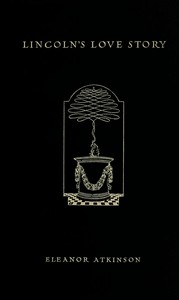
length
8,536 words
a few pages a day
~8 min
finished in
5 days
full read
36 min
At Folio's default of ten pages a day, you finish Lincoln's Love Story in about 5 days — roughly 8 minutes of reading each morning.
The opening
the first pages of Lincoln's Love Story, free
This book was written in a period when many words had not become standardized in their spelling. Words may have multiple spelling variations or inconsistent hyphenation in the text. These have been left unchanged unless indicated with a Transcriber’s Note.
Footnotes are identified in the text with a number in brackets [2] and are displayed at the end of the paragraph.
Transcriber Notes are used when making corrections to the text or to provide additional information for the modern reader. These notes are not identified in the text, but have been accumulated in a single section at the end of the book.
ALL RIGHTS RESERVED, INCLUDING THAT OF TRANSLATION INTO FOREIGN LANGUAGES, INCLUDING THE SCANDINAVIAN
COPYRIGHT, 1908, BY THE CURTIS PUBLISHING COMPANY
COPYRIGHT, 1909, BY DOUBLEDAY, PAGE & COMPANY
PUBLISHED, JANUARY, 1909
NOTE
THIS STORY FIRST APPEARED IN THE “LADIES’ HOME JOURNAL”
UNDER THE TITLE “THE LOVE STORY OF ANN RUTLEDGE.”
ILLUSTRATIONS
“‘I cannot bear to think of her out there alone in the storm’” Frontispiece
FACING PAGE
Above the dam at New Salem 6
The grammar which Lincoln studied as a young man 16
New Salem, Ill., where Lincoln was postmaster 20
Squire Bowling Green’s cabin, near New Salem, Ill., as it is to-day 32
The top of the hill, New Salem 36
Gutzon Borglum’s conception of Lincoln 46
The grave of Ann Rutledge, Oakland Cemetery, Petersburg, Ill. 56
Lincoln’s Love Story
In the sweet spring weather of 1835, Abraham Lincoln made a memorable journey. It was the beginning of his summer of love on the winding banks of the Sangamon. Only one historian has noted it as a happy interlude in a youth of struggle and unsatisfied longings, but the tender memory of Ann Rutledge, the girl who awaited him at the end of it, must have remained with him to the day of his martyrdom.
He was returning from Vandalia, Illinois, then the capital, and his first term in the state legislature, to the backwoods village of New Salem that had been his home for four years. The last twenty miles of the journey, from the town of Springfield, he made on a hired horse. The landscape through which he rode that April morning still holds its enchantment; the swift, bright river still winds in and out among the wooded hills, for the best farming lands lie back of the gravelly bluffs, on the black loam prairie. But three-quarters of a century ago central Illinois was an almost primeval world. Settlements were few and far apart. No locomotive awoke the echoes among the verdant ridges, no smoke darkened the silver ribbon of the river, no coal-mine gashed the green hillside. Here and there a wreath of blue marked the hearth-fire of a forest home, or beyond a gap in the bluff a log-cabin stood amid the warm brown furrows of a clearing; but for the most part the Sangamon River road was broken through a sylvan wilderness.
There were walnut groves then, as there are still oaks and maples. Among the darker boles the trunks of sycamores gleamed. In the bottoms the satin foliage of the cottonwood shimmered in the sun, and willows silvered in the breeze. Honey-locusts, hawthorn and wild crab-apple trees were in bloom, dogwood made pallid patches in the glades and red-bud blushed. Wild flowers of low growth carpeted every grassy slope. The earth exhaled all those mysterious fragrances with which the year renews its youth. In April the mating season would be over and the birds silent, a brooding stillness possess an efflorescent Eden.
It was a long enough ride for a young man to indulge in memories and dreams. A tall, ungainly youth of twenty-six was this rising backwoods politician. He wore a suit of blue jeans, the trousers stuffed in the tops of cowhide boots; a hat of rabbit-fur felt, with so long a nap that it looked not unlike the original pelt, was pushed back from his heavy black hair. But below primitive hat and unruly hair was a broad, high forehead, luminous gray eyes of keen intelligence, softened by sympathy and lit with humour, features of rugged strength, and a wide mouth, full and candid and sweet. His wardrobe was in his saddle-bags; his library of law books, most of them borrowed, in a portmanteau on his saddle-bow; a hundred dollars or so of his pay as a legislator in his belt, and many times that amount pledged to debtors. His present living was precarious; his only capital reputation, courage, self-confidence and a winning personality; his fortune still under his shabby hat.
Keep going from exactly here — Folio remembers your place and serves the next portion tomorrow.
continue reading Lincoln's Love StoryAbout this free edition
Lincoln's Love Story by Eleanor Atkinson (1863-1942) is free to read in full. Folio serves it in daily portions you can actually finish, tracks your streak and reading position across devices, and reads every page aloud with a built-in narrator. The text comes from Project Gutenberg.
More like Lincoln's Love Story
Pride and Prejudice
Jane Austen
Sense and Sensibility
Jane Austen
Emma
Folio
Emma
Jane Austen
Persuasion
Folio
Persuasion
Jane Austen
Mansfield Park
Folio
Mansfield Park
Jane Austen
Jane Eyre
Charlotte Brontë
The Tenant of Wildfell Hall
Folio
The Tenant of Wildfell Hall
Anne Brontë
Agnes Grey
Folio
Agnes Grey
Anne Brontë