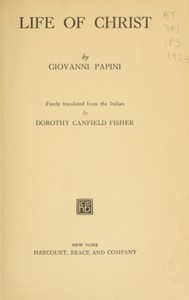
length
160,220 words
a few pages a day
~8 min
finished in
85 days
full read
11h 8m
At Folio's default of ten pages a day, you finish Life of Christ in about 85 days — roughly 8 minutes of reading each morning.
The opening
the first pages of Life of Christ, free
The King James English version has been followed in the Bible quotations of this translation, except in a few cases where an alteration in the Revised Version was evidently the result of a better understanding of the original Greek or Hebrew text.
For the form of proper names, the spelling of the Century Dictionary has been used as a rule; for names not given in the Century, the form current in the usual standard works. Since this book is intended to be popular rather than either scholarly or archæological, it was thought best to use the name-forms best known to most readers.
It will be noted that a number of the quotations are mosaics made up of phrases taken from different parts of the Bible and put together to make one passage. This not being the English usage in such matters, it seems desirable to call the reader’s attention to the character of such quotations.
The only other explanation which may be necessary is in connection with the omission of occasional sentences, paragraphs and of one or two chapters. In the case of individual sentences or phrases, they were usually omitted because they contained an allusion sure to be obscure to non-Italian readers. A characteristic example of such omissions is in the scene of the crucifixion where Christ is described as being nailed to the cross with outstretched arms like an owl nailed with outstretched wings to a barn-door. This revolting country-side custom being unknown to American readers, a reference to it could only cloud the passage.
Since translators into English who omit passages are usually accused of suppressing valuable material which might displease too-narrow Anglo-Saxon readers, it is perhaps as well to explain that the excision of paragraphs here and there, and of a few chapters, is in no sense an expurgation, because this Life of Christ is very much of the same quality throughout. It simply seemed to me that such occasional lightening of the text would make it more acceptable to English-speaking readers, so much less tolerant of long descriptions and minute discussions than Italians.
I quite realize that this may seem a slight and arbitrary basis for making actual excisions in an author’s work, and I understand that the translator is not at all responsible for the matter which he translates, but only for the truthfulness with which he presents the text given him to set into another language. I was moved first by the fact that the passages omitted are of no more importance than any other passages in the book; and secondly by the author’s wish expressly stated in his Introduction, to have this a readable book which will hold those who pick it up, rather than to have it a book of exact learning or great literature. This translation was made with the purpose of allowing the general American reading-public to form an opinion on a book which has aroused a great deal of discussion in modern Italy; and to carry out this purpose, the occasional omissions mentioned and a certain freedom in the rendering of the Italian seemed to me justifiable.
Dorothy Canfield Fisher.
INTRODUCTION
1
For five hundred years those who call themselves free spirits because they prefer prison life to army service have been trying desperately to kill Jesus a second time—to kill Him in the hearts of men.
The army of His enemies assembled to bury Him as soon as they thought they heard the death-rattle of Christ’s second death. Presumptuous donkeys mistaking libraries for their stables, top-heavy brains pretending to explore the highest heavens in philosophy’s drifting balloon, professors poisoned by the fatal strong drink of philology and metaphysics, armed themselves. Paraphrasing the rallying-cry of Peter the Hermit to the crusaders, they shouted “Man wills it!” as they set out on their crusade against the Cross. Certain of them drew on their boundless imaginations to evolve what they considered proof positive of a fantastic theory that the story of the Gospel is no more than a legend from which we can reconstruct the natural life of Jesus as a man, one-third prophet, one-third necromancer, one-third demagogue, a man who wrought no miracles except the hypnotic cure of some obsessed devotees, who did not die on the cross, but came to Himself in the chill of the sepulcher and reappeared with mysterious airs to delude men into believing that He had risen from the dead.
Keep going from exactly here — Folio remembers your place and serves the next portion tomorrow.
continue reading Life of ChristAbout this free edition
Life of Christ by Giovanni Papini (1881-1956) is free to read in full. Folio serves it in daily portions you can actually finish, tracks your streak and reading position across devices, and reads every page aloud with a built-in narrator. The text comes from Project Gutenberg.
More like Life of Christ
Meditations
Folio
Meditations
Marcus Aurelius
The Enchiridion
Epictetus

Thus Spake Zarathustra
Friedrich Nietzsche
Beyond Good and Evil
Folio
Beyond Good and Evil
Friedrich Nietzsche
The Genealogy of Morals
Folio
The Genealogy of Morals
Friedrich Nietzsche
The Republic
Folio
The Republic
Plato
Apology
Folio
Apology
Plato
Crito
Folio
Crito
Plato