length
9,596 words
a few pages a day
~8 min
finished in
6 days
full read
40 min
At Folio's default of ten pages a day, you finish Leo Tolstoy in about 6 days — roughly 8 minutes of reading each morning.
The opening
the first pages of Leo Tolstoy, free
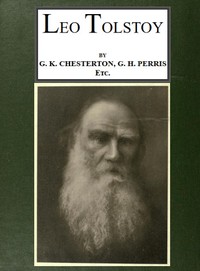
If any one wishes to form the fullest estimate of the real character and influence of the great man whose name is prefixed to these remarks, he will not find it in his novels, splendid as they are, or in his ethical views, clearly and finely as they are conceived and expanded. He will find it best expressed in the news that has recently come from Canada, that a sect of Russian Christian anarchists has turned all its animals loose, on the ground that it is immoral to possess them or control them. About such an incident as this there is a quality altogether independent of the rightness or wrongness, the sanity or insanity, of the view. It is first and foremost a reminder that the world is still young. There are still theories of life as insanely reasonable as those which were disputed under the clear blue skies of Athens. There are still examples of a faith as fierce and practical as that of the Mahometans, who swept across Africa and Europe, shouting a single word. To the languid contemporary politician and philosopher it seems doubtless like something out of a dream, that in this iron-bound, homogeneous, and clockwork age, a company of European men in boots and waistcoats should begin to insist on taking the horse out of the shafts of the omnibus, and lift the pig out of his pig-sty, and the dog out of his kennel, because of a moral scruple or theory. It is like a page from some fairy farce to imagine the Doukhabor solemnly escorting a hen to the door of the yard and bidding it a benevolent farewell as it sets out on its travels. All this, as I
[Illustration: TOLSTOY IN HIS STUDENT DAYS]
say, seems mere muddle-headed absurdity to the typical leader of human society in this decade, to a man like Mr. Balfour, or Mr. Wyndham. But there is nevertheless a further thing to be said, and that is that, if Mr. Balfour could be converted to a religion which taught him that he was morally bound to walk into the House of Commons on his hands, and he did walk on his hands, if Mr. Wyndham could accept a creed which taught that he ought to dye his hair blue, and he did dye his hair blue, they would both of them be, almost beyond description, better and happier men than they are. For there is only one happiness possible or conceivable under the sun, and that is enthusiasm--that strange and splendid word that has passed through so many vicissitudes, which meant, in the eighteenth century the condition of a lunatic, and in ancient Greece the presence of a god.
[Illustration: YASNAYA POLYANA, THE COUNTRY HOME OF COUNT TOLSTOY]
This great act of heroic consistency which has taken place in Canada is the best example of the work of Tolstoy. It is true (as I believe) that the Doukhabors have an origin quite independent of the great Russian moralist, but there can surely be little doubt that their emergence into importance and the growth and mental distinction of their sect, is due to his admirable summary and justification of their scheme of ethics. Tolstoy, besides being a magnificent novelist, is one of the very few men alive who have a real, solid, and serious view of life. He is a Catholic church, of which he is the only member, the somewhat arrogant Pope and the somewhat submissive layman. He is one of the two or three men in Europe, who have an attitude towards things so entirely their own, that we could supply their inevitable view on anything--a silk hat, a Home Rule Bill, an Indian poem, or a pound of tobacco. There are three men in existence who have such an attitude: Tolstoy, Mr. Bernard Shaw, and my friend Mr. Hilaire Belloc. They are all diametrically opposed to each other, but they all have this essential resemblance, that, given their basis of thought, their soil of conviction, their opinions on every earthly subject grow there naturally, like flowers in a field. There are certain views of certain things that they must take: they do not form opinions, the opinions form themselves. Take, for instance, in the case of Tolstoy, the mere list of miscellaneous objects which I wrote down at random above, a silk hat, a Home Rule Bill, an Indian poem, and a pound of tobacco. Tolstoy would say: “I believe in the utmost possible simplification of life; therefore, this silk hat is a black abortion.” He would say: “I believe in the utmost possible simplification of life; therefore, this Home Rule Bill is a mere peddling compromise; it is no good to break up a centralised empire into nations, you must break the nation up into individuals.” He would say: “I believe in the utmost possible simplification of life; therefore, I am interested in this Indian poem, for Eastern ethics, under all their apparent gorgeousness, are far simpler and more Tolstoyan than Western.” He would say: “I believe in the utmost possible simplification of life; therefore, this pound of tobacco is a thing of evil; take it away.” Everything in the world, from the Bible to a bootjack, can be, and is, reduced by Tolstoy to this great fundamental Tolstoyan principle, the simplification of life. When we deal with a body of opinion like this we are dealing with an incident in the history of Europe infinitely more important than the appearance of Napoleon Buonaparte.
Keep going from exactly here — Folio remembers your place and serves the next portion tomorrow.
continue reading Leo TolstoyAbout this free edition
Leo Tolstoy by G. K. Chesterton (1874-1936) is free to read in full. Folio serves it in daily portions you can actually finish, tracks your streak and reading position across devices, and reads every page aloud with a built-in narrator. The text comes from Project Gutenberg.
More like Leo Tolstoy
The Innocence of Father Brown
G. K. Chesterton
The Man Who Was Thursday
G. K. Chesterton
The Wisdom of Father Brown
Folio
The Wisdom of Father Brown
G. K. Chesterton
The Club of Queer Trades
Folio
The Club of Queer Trades
G. K. Chesterton
The Man Who Knew Too Much
Folio
The Man Who Knew Too Much
G. K. Chesterton
Manalive
G. K. Chesterton
The Trees of Pride
Folio
The Trees of Pride
G. K. Chesterton
The secret of Father Brown
G. K. Chesterton