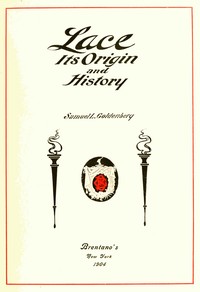
Lace, Its Origin and History
free to read
length
18,495 words
a few pages a day
~8 min
finished in
10 days
full read
1h 17m
At Folio's default of ten pages a day, you finish Lace, Its Origin and History in about 10 days — roughly 8 minutes of reading each morning.
The opening
the first pages of Lace, Its Origin and History, free
"I have here only a nosegay of culled flowers, and have brought nothing of my own but the thread that ties them together."--Montaigne.
The task of the author of this work has not been an attempt to brush the dust of ages from the early history of lace in the hope of contributing to the world's store of knowledge on the subject. His purpose, rather, has been to present to those whose relation to lace is primarily a commercial one a compendium that may, perchance, in times of doubt, serve as a practical guide.
Though this plan has been adhered to as closely as possible, the history of lace is so interwoven with life's comedies and tragedies, extending back over five centuries, that there must be, here and there in the following pages, a reminiscent tinge of this association.
Lace is, in fact, so indelibly associated with the chalets perched high on mountain tops, with little cottages in the valleys of the Appenines and Pyrenees, with sequestered convents in provincial France, with the raiment of men and women whose names loom large in the history of the world, and the futile as well as the successful efforts of inventors to relieve tired eyes and weary fingers, that, no matter how one attempts to treat the subject, it must be colored now and again with the hues of many peoples of many periods.
The author, in avowing his purpose to give this work a practical cast, does not wish to be understood as minimizing the importance of any of the standard works compiled by those whose years of study and research among ancient volumes and musty manuscripts in many tongues have been a labor of love. Rather would he pay the meed of tribute to those who have preserved to posterity the facts bearing upon the early history of lace, which have been garnered with such great care.
Nevertheless, most of these works, necessarily voluminous and replete with detail, are more for the connoisseur or dilettante than for the busy man of affairs upon whom the practical aspect of lace, quite dissociated from the romance in which it is steeped, always forces itself.
It is for men of this type, and with no little misgiving, and a full appreciation of how far short of his ideal the volume must be, that the author has undertaken the compilation of this work.
SAMUEL L. GOLDENBERG.
[Illustration]
{1}
LACE:
Its Origin and History.
* * * * *
When where and how lace had its origin no one will pretend to say. There is a general agreement, however, that lace, as the term is understood to-day, is a comparatively modern product, it being impossible to identify any of the antique specimens preserved from the ravages of time as belonging to a period further back than the early part of the sixteenth century.
True it is that there are specimens of woven fabrics of a lacelike character which were undoubtedly made at an earlier date, but most of the authorities who have delved deep into the subject are of opinion that lace probably does not antedate A. D. 1500.
A perusal of the available records in many tongues fails to make clear just where lace was first made. Spain, Italy, Belgium, France and Germany have all claimed the honor, and each has been able to present a great deal of testimony in support of its contention; but the records of early times are so meagre and indefinite that it is impossible to bestow the coveted honor for the discovery of the art upon any one nation. {2}
Keep going from exactly here — Folio remembers your place and serves the next portion tomorrow.
continue reading Lace, Its Origin and HistoryAbout this free edition
Lace, Its Origin and History by Samuel L. Goldenberg is free to read in full. Folio serves it in daily portions you can actually finish, tracks your streak and reading position across devices, and reads every page aloud with a built-in narrator. The text comes from Project Gutenberg.
More like Lace, Its Origin and History
The History of the Peloponnesian War
Folio
The History of the Peloponnesian War
Thucydides
The History of Herodotus
Folio
The History of Herodotus
Herodotus
The Gallic Wars
Folio
The Gallic Wars
Julius Caesar
Anabasis
Folio
Anabasis
Xenophon
The Lives of the Twelve Caesars
Folio
The Lives of the Twelve Caesars
Suetonius
Germania
Folio
Germania
Tacitus

The History of the Decline and Fall of the Roman Empire
Edward Gibbon
The Travels of Marco Polo
Marco Polo