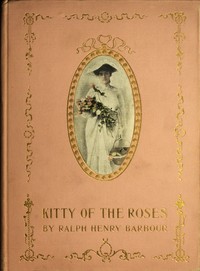
length
17,822 words
a few pages a day
~8 min
finished in
10 days
full read
1h 14m
At Folio's default of ten pages a day, you finish Kitty of the Roses in about 10 days — roughly 8 minutes of reading each morning.
The opening
the first pages of Kitty of the Roses, free
Through the wide-open window floated in the fragrance of dew-dripping flowers. On the edge of the table a smouldering cigarette sent up a thin, wavering filament of gray smoke that lost itself in the upper gloom of the darkened room, leaving behind it a not-unpleasing odor of the Orient to mingle with the incense from the gardens without. When he paused in his writing--and pauses were frequent--Mr. Stephen Burton’s gaze invariably wandered to the sunlighted morning world represented by the vista at his elbow.
[Illustration]
Immediately below him a small, turf-carpeted garden formed a square of shadow and sunlight. A jasmine clambered and sprawled along the purple brick wall at the rear, and a narrow, chocolate-hued bed of moist loam caught the fallen blooms. The bed held white and purple and lavender iris, and spiræa, and blue pentstemon, and was bordered with honey-flower. At the end of the old wall, where it formed an angle with an iron fence, a queerly shaped Daphne-tree threw grotesque shadows on the little lawn. But it was beyond the rusty iron barrier that Burton’s eyes found their richest reward.
[Illustration]
There stretched a quadrangle that was bounded by walls on two sides and at the farther end by the back of an old-fashioned Southern house, staid and sleepy-looking, whose second-story porch, half hidden by vines over white-painted iron lattice-work, held a hammock which ever since Burton’s coming had remained idle, swinging lazily in the afternoon breezes. The quadrangle was intersected by narrow red gravel paths bordered by box hedges waist-high. And between the hedges, against the walls, along the fence, and clambering upon the house were roses. Never had Burton seen or dreamed of such roses. The garden was a riot of intense reds, of tender pinks, of flaring yellows and dazzling whites, and of every hue and tint between.
[Illustration]
For the most part, they were the favorites of a generation gone: Banksias, festooning the warm bricks with bouquets of amber yellow and of violet-tinged white; Baltimore Belles, creamy-hued and graceful; rosy-violet Pride of Washingtons; sweetbriers of scarlet and blush; Austrian briers, single blossoms of flame-yellow. In the beds were great cabbage-roses of delicate, clear pink and of deep rose; moss-roses of many sorts, crimson Damasks, bright-red Luxembourgs, tiny clusters of flesh-colored Pompons. An immense bush of Gloire des Jardins was aflame with its great double blooms of red, while clustered about it were Madame Cottins, Philippe Quatres, Marceaus, Madame Hardys, Princess Clementines, and Madame Plantiers. The rich crimson, cup-shaped blossoms of a George the Fourth were nodding regally over the yellow-pink blooms of an Emmeline; the brown velvet petals of a Lord Nelson were clustering above a lowly Wellington; while, supreme in one three-cornered jungle of color, a spreading bush of Queen Victoria, an offshoot of the parent stem, showered the ground with its glowing petals.
[Illustration]
Above the farther wall leaned a magnolia, a portly, eminently respectable magnolia, spreading its long branches far out over the garden as though offering old-gentlemanly protection to the rose-ladies. In the long afternoons the green and bronze foliage, now reflecting the morning sunlight from its varnished surface, made a pleasant gloom thereabouts, throwing great gently-moving ovals of greenish shadow over the rosebushes along the old wall; here was the Giant of Battles, with petals so darkly red as to verge upon black, and the Duchess, with old-fashioned blooms, globular, chary of petals, showing yellow at the heart when fully opened to the sun, and of a rare old shade of pink that made one think of lavender-scented brocades and was like the inner surface of a sea-shell.
[Illustration]
Many a rose bloomed there whose name was no longer known, whose origin was forgotten with its grower, but which, nameless and unpretentious, leafed and budded and flowered season after season, year after year, gladly and humbly fulfilling its mission and setting an example which many of the far-heralded and perverse beauties of the garden might well have emulated.
Keep going from exactly here — Folio remembers your place and serves the next portion tomorrow.
continue reading Kitty of the RosesAbout this free edition
Kitty of the Roses by Ralph Henry Barbour (1870-1944) is free to read in full. Folio serves it in daily portions you can actually finish, tracks your streak and reading position across devices, and reads every page aloud with a built-in narrator. The text comes from Project Gutenberg.
More like Kitty of the Roses
The Adventure Club Afloat
Folio
The Adventure Club Afloat
Ralph Henry Barbour
The Lilac Girl
Folio
The Lilac Girl
Ralph Henry Barbour

The Land of Joy
Ralph Henry Barbour

A Maid in Arcady
Ralph Henry Barbour

Pride and Prejudice
Jane Austen

Sense and Sensibility
Jane Austen
Emma
Folio
Emma
Jane Austen
Persuasion
Folio
Persuasion
Jane Austen