length
5,831 words
a few pages a day
~8 min
finished in
4 days
full read
24 min
At Folio's default of ten pages a day, you finish John Deere's Steel Plow in about 4 days — roughly 8 minutes of reading each morning.
The opening
the first pages of John Deere's Steel Plow, free
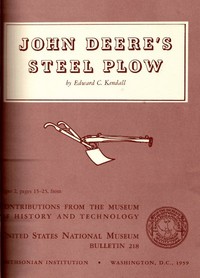
_John Deere in 1837 invented a plow that could be used successfully in the sticky, root-filled soil of the prairie. It was called a steel plow. Actually, it appears that only the cutting edge, the share, on the first Deere plows was steel. The moldboard was smoothly ground wrought iron._
Deere's invention succeeded because, as the durable steel share of the plow cut through the heavy earth, the sticky soil could find no place to cling on its polished surfaces.
Americans moving westward in the beginning of the 19th century soon encountered the prairie lands of what we now call the Middle West. The dark fertile soils promised great rewards to the farmers settling in these regions, but also posed certain problems. First was the breaking of the tough prairie sod. The naturalist John Muir describes the conditions facing prairie farmers when he was a boy in the early 1850's as he tells of the use of the big prairie-breaking plows in the following words:[1]
They were used only for the first ploughing, in breaking up the wild sod woven into a tough mass, chiefly by the cord-like roots of perennial grasses, reinforced by the tap roots of oak and hickory bushes, called "grubs," some of which were more than a century old and four or five inches in diameter.... If in good trim, the plough cut through and turned over these grubs as if the century-old wood were soft like the flesh of carrots and turnips; but if not in good trim the grubs promptly tossed the plough out of the ground.
The second and greater problem was that the richer lands of the prairie bottoms, after a few years of continuous cultivation, became so sticky that they clogged the moldboards of the plows. Clogging was such a factor in prairie plowing that farmers in these regions carried a wooden paddle solely for cleaning off the moldboard, a task which had to be repeated so frequently that it seriously interfered with plowing efficiency. It seems probable that by the 1830's blacksmiths in the prairie country were beginning to solve the problem of continuous cultivation of sticky prairie soil by nailing strips of saw steel to the face of wooden moldboard of the traditional plows. Figure 1 is a photograph of an 18th century New England plow in the collection of the U. S. National Museum. This is one type of plow which was brought west by the settlers. It contributed to the development of the prairie breaker shown in figure 2. The first plow on record with strips of steel on the moldboard is attributed to John Lane in Chicago in 1833.[2] Steel presented a smoother surface which shed the sticky loam better than the conventional wooden moldboards covered with wrought iron, or the cast iron moldboards of the newer factory-made plows then coming into use.
It is generally accepted as historical fact that John Deere made his first steel plow in 1837 at Grand Detour, Illinois. The details of the construction of this plow have been variously given by different writers. Ardrey[3] and Davidson[4] describe Deere's original plow as having a wooden moldboard covered with strips of steel cut from a saw, in the manner of the John Lane plow.
[Sidebar: THE AUTHOR:
Edward C. Kendall is curator of agriculture, Museum of History and Technology, in the Smithsonian Institution's United States National Museum.]
Keep going from exactly here — Folio remembers your place and serves the next portion tomorrow.
continue reading John Deere's Steel PlowAbout this free edition
John Deere's Steel Plow by Edward C. Kendall is free to read in full. Folio serves it in daily portions you can actually finish, tracks your streak and reading position across devices, and reads every page aloud with a built-in narrator. The text comes from Project Gutenberg.
More like John Deere's Steel Plow
The History of the Peloponnesian War
Folio
The History of the Peloponnesian War
Thucydides
The History of Herodotus
Folio
The History of Herodotus
Herodotus
The Gallic Wars
Folio
The Gallic Wars
Julius Caesar
Anabasis
Folio
Anabasis
Xenophon
The Lives of the Twelve Caesars
Folio
The Lives of the Twelve Caesars
Suetonius
Germania
Folio
Germania
Tacitus

The History of the Decline and Fall of the Roman Empire
Edward Gibbon
The Travels of Marco Polo
Marco Polo