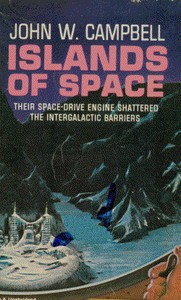
length
62,848 words
a few pages a day
~8 min
finished in
34 days
full read
4h 22m
At Folio's default of ten pages a day, you finish Islands of Space in about 34 days — roughly 8 minutes of reading each morning.
The opening
the first pages of Islands of Space, free
As Earth's faster-than-light spaceship hung in the void between galaxies, Arcot, Wade, Morey and Fuller could see below them, like a vast shining horizon, the mass of stars that formed their own island universe. Morey worked a moment with his slide rule, then said, "We made good time! Twenty-nine light years in ten seconds! Yet you had it on at only half power...."
Arcot pushed the control lever all the way to full power. The ship filled with the strain of flowing energy, and sparks snapped in the air of the control room as they raced at an inconceivable speed through the darkness of intergalactic space.
But suddenly, far off to their left and far to their right, they saw two shining ships paralleling their course! They held grimly to the course of the Earth ship, bracketing it like an official guard.
The Earth scientists stared at them in wonder. "Lord," muttered Morey, "where can they have come from?"
* * * * *
John W. Campbell first started writing in 1930 when his first short story, When the Atoms Failed, was accepted by a science-fiction magazine. At that time he was twenty years old and still a student at college. As the title of the story indicates, he was even at that time occupied with the significance of atomic energy and nuclear physics.
For the next seven years, Campbell, bolstered by a scientific background that ran from childhood experiments, to study at Duke University and the Massachusetts Institute of Technology, wrote and sold science-fiction, achieving for himself an enviable reputation in the field.
In 1937 he became the editor of Astounding Stories magazine and applied himself at once to the task of bettering the magazine and the field of s-f writing in general. His influence on science-fiction since then has been great. Today he still remains as the editor of that magazine's evolved and redesigned successor, Analog.
ISLANDS
OF
SPACE
by
JOHN W. CAMPBELL
ACE BOOKS, INC. 1120 Avenue of the Americas New York, N.Y. 10036
ISLANDS OF SPACE
Copyright, 1956, by John W. Campbell, Jr. Copyright, 1930, by Experimenter Publications, Inc.
An Ace Book, by arrangement with the author.
All Rights Reserved
Cover by McKeon
Also by John W. Campbell In Ace editions:
THE BLACK STAR PASSES (F-346) THE MIGHTIEST MACHINE (F-364)
Printed in U.S.A.
[Illustration]
PROLOGUE
In the early part of the Twenty Second Century, Dr. Richard Arcot, hailed as "the greatest living physicist", and Robert Morey, his brilliant mathematical assistant, discovered the so-called "molecular motion drive", which utilized the random energy of heat to produce useful motion.
John Fuller, designing engineer, helped the two men to build a ship which used the drive in order to have a weapon to seek out and capture the mysterious Air Pirate whose robberies were ruining Transcontinental Airways.
The Pirate, Wade, was a brilliant but neurotic chemist who had discovered, among other things, the secret of invisibility. Cured of his instability by modern psychomedical techniques, he was hired by Arcot to help build an interplanetary vessel to go to Venus.
The Venusians proved to be a humanoid race of people who used telepathy for communication. Although they were similar to Earthmen, their blue blood and double thumbs made them enough different to have caused distrust and racial friction, had not both planets been drawn together in a common bond of defense by the passing of the Black Star.
Keep going from exactly here — Folio remembers your place and serves the next portion tomorrow.
continue reading Islands of SpaceAbout this free edition
Islands of Space by John W. Campbell (1910-1971) is free to read in full. Folio serves it in daily portions you can actually finish, tracks your streak and reading position across devices, and reads every page aloud with a built-in narrator. The text comes from Project Gutenberg.
More like Islands of Space
The Black Star Passes
John W. Campbell
Invaders from the Infinite
Folio
Invaders from the Infinite
John W. Campbell
The Ultimate Weapon
Folio
The Ultimate Weapon
John W. Campbell
The Last Evolution
Folio
The Last Evolution
John W. Campbell
The Time Machine
H. G. Wells

The War of the Worlds
H. G. Wells
The Invisible Man
H. G. Wells
The Island of Doctor Moreau
H. G. Wells