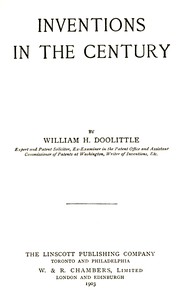
length
139,409 words
a few pages a day
~8 min
finished in
74 days
full read
9h 41m
At Folio's default of ten pages a day, you finish Inventions in the century in about 74 days — roughly 8 minutes of reading each morning.
The opening
the first pages of Inventions in the century, free
The history of inventions is the history of new and useful contrivances made by man for practical purposes. The history of scientific discoveries is the record of new things found in Nature, its laws, forces, or materials, and brought to light, as they exist, either singly, or in relation, or in combination.
Thus Galileo invented the telescope, and Newton discovered the law of gravitation. The practical use of the invention when turned to the heavenly bodies served to confirm the truth of the discovery.
Discovery and invention may be, and often are, united as the soul is to the body. The union of the two produces one or more inventions. Thus the invented electro-telegraph consists of the combination of discoveries of certain laws of electricity with an apparatus, by which signs are communicated to distances by electrical influence.
Inventions and discoveries do not precede or follow each other in order. The instrument may be made before the laws which govern its operation are discovered. The discovery may long precede its adaptation in physical form, and both the discovery and adaptation may occur together.
Among the great inventions of the past are alphabetical writing, Arabic notation, the mariner’s compass, the telescope, the printing-press, and the steam-engine. Among the great discoveries of the past are the attraction of gravitation, the laws of planetary motion, the circulation of the blood, and velocity of light. Among the great inventions of the nineteenth century are the spectroscope, the electric telegraph, the telephone, the phonograph, the railways, and the steam-ships. Among the great discoveries of this century are the correlation and conservation of forces, anæsthetics, laws of electrical energy, the germ theory of disease, the molecular theory of gases, the periodic law of Mendeljeff in chemistry, antiseptic surgery, and the vortex theory of matter. This short enumeration will serve to indicate the different roads along which inventions and the discoveries of science progress.
By many it is thought that the inventions and discoveries of the nineteenth century exceed in number and importance all the achievements of the kind in all the ages of the past.
So marvellous have been these developments of this century that, not content with sober definitions, men have defined invent, even when speaking only of mechanical productions, as “creating what had not before existed;” and this period has been described as an age of new creations. The far-off cry of the Royal Preacher, “There is no new thing under the sun: Is there anything whereof it may be said, see this is new, it hath been already of old time which was before us,” is regarded as a cry of satiety and despair, finding no responsive echo in the array of inventions of this bright age.
But in one sense the Preacher’s words are ever profoundly true. The forces and materials of Nature always exist, awaiting man’s discovery, and at best he can but vary their relations, re-direct their course, or change their forms. In a still narrower sense the truth of the Preacher’s declaration is apparent:--
In an address before the Anthropological Society of Washington in 1885, the late Prof. F. A. Seely, of the United States Patent Office, set forth that it was one of the established laws of Invention, that,
Keep going from exactly here — Folio remembers your place and serves the next portion tomorrow.
continue reading Inventions in the centuryAbout this free edition
Inventions in the century by William H. Doolittle (1844-1904) is free to read in full. Folio serves it in daily portions you can actually finish, tracks your streak and reading position across devices, and reads every page aloud with a built-in narrator. The text comes from Project Gutenberg.
More like Inventions in the century
The History of the Peloponnesian War
Folio
The History of the Peloponnesian War
Thucydides
The History of Herodotus
Folio
The History of Herodotus
Herodotus
The Gallic Wars
Folio
The Gallic Wars
Julius Caesar
Anabasis
Folio
Anabasis
Xenophon
The Lives of the Twelve Caesars
Folio
The Lives of the Twelve Caesars
Suetonius
Germania
Folio
Germania
Tacitus

The History of the Decline and Fall of the Roman Empire
Edward Gibbon
The Travels of Marco Polo
Marco Polo