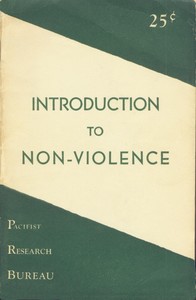
Introduction to Non-Violence
first published 1944 · free to read
length
26,549 words
a few pages a day
~8 min
finished in
14 days
full read
1h 51m
At Folio's default of ten pages a day, you finish Introduction to Non-Violence in about 14 days — roughly 8 minutes of reading each morning.
The opening
the first pages of Introduction to Non-Violence, free
The Pacifist Research Bureau is financed entirely by the contributions of organizations and individuals who are interested in seeing this type of research carried on. We trust that you may desire to have a part in this positive pacifist endeavor to aid in the formulation of plans for the world order of the future. Please make contributions payable to The Pacifist Research Bureau, 1201 Chestnut Street, Philadelphia 7, Pennsylvania. Contributions are deductible for income tax purposes.
DIRECTOR'S FOREWORD
"When I use a word," Humpty Dumpty said, in a rather scornful tone, "it means just what I choose it to mean--neither more nor less."
"The question is," said Alice, "whether you can make words mean different things."
* * * * *
In the writings of pacifists and non-pacifists concerning theories of and experiences with non-violence, there is a clear lack of uniformity in the use of words.
The present booklet, introducing the Bureau's new series on Non-Violent Action in Tension Areas, distinguished by green covers, critically examines pacifist terminology. But it does more, for it analyzes various types of non-violence, evaluates examples of non-violence referred to in previous literature, and points to new sources of case material.
Dr. Theodore Paullin, Assistant Director of the Bureau, is the author of this study. The manuscript has been submitted to and reviewed by Professor Charles A. Ellwood and Professor Hornell Hart, both of the Department of Sociology, Duke University; and by Richard B. Gregg, author of several works on the philosophy and practice of non-violence. Their criticisms and suggestions have proved most helpful, but for any errors of interpretation the author is responsible.
The Pacifist Research Bureau frankly bases its work upon the philosophy of pacifism: that man should exercise such respect for human personality that he will employ only love and sacrificial good will in opposing evil and that the purpose of all human endeavor should be the creation of a world brotherhood in which cooperative effort contributes to the good of all. A list of pamphlets published or in preparation appears on the back cover.
HARROP A. FREEMAN, Executive Director
_Any organization ordering 500 or more copies of any pamphlet published by the Pacifist Research Bureau may have its imprint appear on the title page along with that of the Bureau. The prepublication price for such orders is $75.00 for each 500 copies._
* * * * *
TABLE OF CONTENTS
I. INTRODUCTION: ON TERMS 1 Definition of Terms 5
II. VIOLENCE WITHOUT HATE 9 Revolutionary Anarchism 10 Abraham Lincoln 11 The Church and War 11
III. NON-VIOLENCE BY NECESSITY 12 Non-Violent Resistance to Invaders 13 Chinese Boycotts Against Foreigners 15 Egyptian Opposition to Great Britain 16
IV. NON-VIOLENT COERCION 17 The Labor Strike 19 The Boycott 21 Non-Violent Coercion by the American Colonies 22 Irish Opposition to Great Britain After 1900 23 Strikes with Political Purposes 24 Non-Violence in International Affairs 24
V. SATYAGRAHA OR NON-VIOLENT DIRECT ACTION 25 The Origins of Satyagraha 26 The Process of Satyagraha 27 The Philosophy of Satyagraha 29 The Empirical Origins of Gandhi's Method 31 Non-Cooperation 32 Fasting 33 The American Abolition Movement 34
VI. NON-RESISTANCE 36 The Mennonites 37 The New England Non-Resistants 39 Tolstoy 41
VII. ACTIVE GOODWILL AND RECONCILIATION 43 Action in the Face of Persecution 44 Coercion or Persuasion? 46 Ministering to Groups in Conflict 47 The Power of Example 48 Work for Social Reform 49 Political Action and Compromise 50 The Third Alternative 51
VIII. CONCLUSIONS 54
* * * * *
PREFACE
Keep going from exactly here — Folio remembers your place and serves the next portion tomorrow.
continue reading Introduction to Non-ViolenceAbout this free edition
Introduction to Non-Violence by Theodore Paullin is free to read in full. Folio serves it in daily portions you can actually finish, tracks your streak and reading position across devices, and reads every page aloud with a built-in narrator. The text comes from Project Gutenberg.
More like Introduction to Non-Violence
Meditations
Folio
Meditations
Marcus Aurelius

The Enchiridion
Epictetus

Thus Spake Zarathustra
Friedrich Nietzsche
Beyond Good and Evil
Folio
Beyond Good and Evil
Friedrich Nietzsche
The Genealogy of Morals
Folio
The Genealogy of Morals
Friedrich Nietzsche
The Republic
Folio
The Republic
Plato
Apology
Folio
Apology
Plato
Crito
Folio
Crito
Plato