length
148,690 words
a few pages a day
~8 min
finished in
79 days
full read
10h 20m
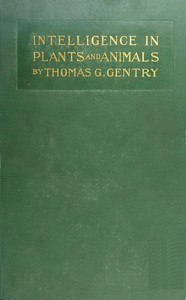
At Folio's default of ten pages a day, you finish Intelligence in Plants and Animals in about 79 days — roughly 8 minutes of reading each morning.
The opening
the first pages of Intelligence in Plants and Animals, free
Nothing is more charming to the mind of man than the study of Nature. Religion, moderation and magnanimity have been made a part of his inner being through her teachings, and the soul has been rescued by her influence from obscurity. No longer doth man grovel in the dust, seeking, animal-like, the gratification of low and base desires, as was his wont, but on the wings of thought is enabled to soar to the very gates of Heaven and hold communion with God.
Though made “a little lower than the angels,” yet, through the mighty play of forces that have been at work in the world, which we, in the latter half of this enlightened century, are just beginning to recognize and comprehend, he has been lifted from the mire of degradation and placed upon a higher social, intellectual, moral and spiritual level. Out of the animal, in the scheme of Deity, the spiritual system of things is to be elaborated, and not the animal out of the spiritual. This natural world, so to speak, is the raw material of the spiritual. Therefore, ere man can understand the spiritual, he must understand the natural. Though his knowledge was at first about material things, or such as pertained to natural phenomena, yet from this through the ages has been builded, little by little, that mountain-height of knowledge, intellectual and moral, which, if rightly directed, is to bring him into fellowship with Deity. “As we have borne the image of the earthy, we shall also bear the image of the heavenly,” or, Lord from heaven.
When is considered, therefore, the immense good which the study and investigation of nature have accomplished, it is not at all surprising that the literature on the subject should be markedly in the ascendant. Natural science bids fair to be in a preëminent degree the pursuit of the coming man. There is no end to the books that have been written upon the subject during the past few decades, if not by specialists, but by men and women who have been well informed and who have made themselves fully capable of contemplating understandingly the world which lies about them.
Our libraries are to-day quite affluent in books that are the handmaids of natural science. Michelet and Hugh Miller, in their day, opened glorious new worlds before a rising generation, and that generation is now doing excellent work under the inspiration of the impetus which it then received. Tait, Balfour Stewart, Dawson, Gray, McCook, Thompson, Scudder, Mrs. Treat, Olive Thorne Miller and others have done much to continue the interest, pleasure and enthusiasm awakened by those earlier writers, and even Darwin and Huxley themselves, in detailing their experiments, have not scorned to bring their thoughts within the range of narrower minds.
But in the popularization of natural science no man has done more than Rev. J. G. Wood in his numerous works. Not only have his writings created in thousands a taste for nature-studies, but they have been no less the means of cultivating the observation, awakening enthusiasm and directing effort in the lines of original research and discovery. Certainly no one, as his many writings so abundantly attest, possessed a larger fund of knowledge concerning the powers and capabilities of the lower animals than this author. Few knew our domestic animals better than he, and none was more capable of judging of the mental and moral status which they should occupy in the world of animals. It is true that men and women, eminent in theology, literature and science, had expressed a belief in the idea that the “latent powers and capacities” of the lower animals might be developed in a future life, but no one had felt secure enough in this belief to warrant more than a passing thought or two upon the subject.
Keep going from exactly here — Folio remembers your place and serves the next portion tomorrow.
continue reading Intelligence in Plants and AnimalsAbout this free edition
Intelligence in Plants and Animals by Thomas G. Gentry (1843-1905) is free to read in full. Folio serves it in daily portions you can actually finish, tracks your streak and reading position across devices, and reads every page aloud with a built-in narrator. The text comes from Project Gutenberg.
More like Intelligence in Plants and Animals
Meditations
Folio
Meditations
Marcus Aurelius
The Enchiridion
Epictetus

Thus Spake Zarathustra
Friedrich Nietzsche
Beyond Good and Evil
Folio
Beyond Good and Evil
Friedrich Nietzsche
The Genealogy of Morals
Folio
The Genealogy of Morals
Friedrich Nietzsche
The Republic
Folio
The Republic
Plato
Apology
Folio
Apology
Plato
Crito
Folio
Crito
Plato