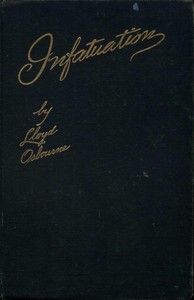
length
72,266 words
a few pages a day
~8 min
finished in
39 days
full read
5h 1m
At Folio's default of ten pages a day, you finish Infatuation in about 39 days — roughly 8 minutes of reading each morning.
The opening
the first pages of Infatuation, free
Phyllis Ladd lost her mother at twelve; and this bereavement, especially terrible to an only child, brought with it two consequences that had a far-reaching effect on her character. An ardent, high-strung nature, acquainted so early with a poignant sorrow, gets an outlook on the world that is so just and true as to constitute a misfortune in itself. A child ought not to think; ought not to suffer; ought not to understand. Individuality, sympathy, sensibility awaken--qualities that go to make a charming human being--but which have to be paid for in the incessant balance of our complex existence. Phyllis' school-fellows were no longer the same to her; she felt herself a person apart; though she played as gaily as any of them, and chattered her head off, and tripped blithely along Chestnut Avenue entwined in the arms of her companions, she was aware, down in her secret heart, that she was "different."
At twelve, then, her path diverged from the commonplace, in which, as we all have to admit, however reluctantly, the chances for a happy life are best.
The second consequence of her mother's death was to bring her into contact with a scarcely known individual--her father. This grave, handsome man, who sat behind a newspaper at breakfast, and who was not seen again till dinner time; who drove away every morning behind a liveried coachman and a pair of shining bays to a region called "the office"; whose smile and voice were always a shy delight to her--this demigod, admired, unknown, from whom there emanated a delicious sense of security and strength, now suddenly drew her to his heart, and became her world, her all.
Robert T. R. Ladd was the president of the K. B. and O. Railway. Rich himself, and the son of a rich man, his interests in Carthage were varied and many, engaging his activities far beyond the great road that was associated with his name. Carthage was an old-fashioned city; and the boys who had grown up together and succeeded their fathers were clannish to a degree little known in the newer parts of this country. Joe, who was prominent in electricity and gas, might want to consolidate a number of scattered plants, and to that end would seek the assistance of Tom and Harry and Bob. George, perhaps, in forecasting the growth of Carthage a little too generously, was in temporary straits with his land-scheme--well, he would ask Tom and Bob to tide him over, making a company of himself, and taking them in. Frank and his brother, in converting their private bank into the Fifth National--induced as much as anything by the vanity of seeing their own names on their own greenbacks--would feel the need of a strong local man on the new directorate. Would Bob oblige them? "Why, with pleasure, though if somebody else would do as well--" "Oh, we must have you, old fellow."
Such was Carthage--at least the Carthage of Chestnut Avenue, of the long lines of stately and beautiful mansions on what was called the West Side, the Carthage that supported the Symphony Orchestra, owned the parterre boxes at the opera, dined, drove, danced, and did business together--as compact and jealous a little aristocracy as any in Hungary or Silesia. Of course there was another Carthage--several other Carthages--one a teeming riverside quarter where English was an unknown tongue, a place black with factory chimneys, full of noise and refuse, dirt and ugliness, where forty thousand nondescript foreigners pigged together, and contributed forty thousand pairs of very grimy and unwilling hands to the material advancement of the city and state. There was a business Carthage, with banks and sky-scrapers, and vast webs of wires that darkened the sky. There was a pleasure Carthage that awoke only at night, blazing out with a myriad lights, and a myriad enticements. There was a middle-class residence Carthage; a second-class residence Carthage; an immense, poor, semi-disreputable, altogether dreary Carthage that was popularly alluded to as "South of the slot," the name dating from the time of the first cable-car line, now long since discarded.
Keep going from exactly here — Folio remembers your place and serves the next portion tomorrow.
continue reading InfatuationAbout this free edition
Infatuation by Lloyd Osbourne (1868-1947) is free to read in full. Folio serves it in daily portions you can actually finish, tracks your streak and reading position across devices, and reads every page aloud with a built-in narrator. The text comes from Project Gutenberg.
More like Infatuation
Love, the Fiddler
Folio
Love, the Fiddler
Lloyd Osbourne
The Motormaniacs
Folio
The Motormaniacs
Lloyd Osbourne
Pride and Prejudice
Jane Austen
Sense and Sensibility
Jane Austen
Emma
Folio
Emma
Jane Austen
Persuasion
Folio
Persuasion
Jane Austen
Mansfield Park
Folio
Mansfield Park
Jane Austen
Jane Eyre
Charlotte Brontë