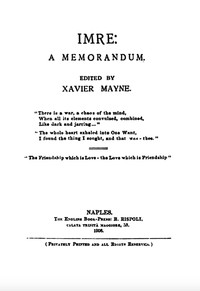
length
35,352 words
a few pages a day
~8 min
finished in
19 days
full read
2h 27m
At Folio's default of ten pages a day, you finish Imre: A Memorandum in about 19 days — roughly 8 minutes of reading each morning.
The opening
the first pages of Imre: A Memorandum, free
In these pages I give you a chapter out of my life... an episode that at first seemed impossible to write even to you. It has lengthened under my hand, as autobiography is likely to do. My apology is that in setting forth absolute truth in which we ourselves are concerned so deeply, the perspectives, and what painters call the values, are not easily maintained. But I hope not to be tedious to the reader for whom, especially, I have laid open as mysterious and profoundly personal an incident.
You know why it has been written at all for you. Now that it lies before me, finished, I do not feel so dubious of what may be thought of its utterly sincere course as I did when I began to put it on paper. And as you have more than once urged me to write something concerning just that topic which is the mainspring of my pages I have asked myself whether, instead of some impersonal essay, I would not do best to give over to your editorial hand all that is here?--as something for other men than for you and me only? Do with it, therefore, as you please. As speaking out to any other human heart that is throbbing on in rebellion against the ignorances, the narrow psychologic conventions, the false social ethics of our epoch--too many men's hearts must do so!--as offered in a hope that some perplexed and solitary soul may grow a little calmer, may feel itself a little less alone in our world of mysteries--so do I give this record to you, to use it as you will. Take it as from Imre and from me.
As regards the actual narrative, I may say to you here that the dialogue is kept, word for word, faithfully as it passed, in all the more significant passages; and that the correspondence is literally translated.
I do not know what may be the exact shade of even your sympathetic judgment, as you lay down the manuscript, read. But, for myself, I put by my pen after the last lines were written, with two lines of Platen in my mind that had often recurred to me during the progress of my record: as a hope, a trust, a conviction:
"Ist's möglich ein Geschöpf in der Natur zu sein, Und stets und wiederum auf falscher Spur zu sein?
Or, as the question of the poet can be put into English:
"Can one created be--of Nature part-- And ever, ever trace a track that's false?
No... I do not believe it!
Faithfully yours,
Oswald.
Velencze, 19--
... "You have spoken of homosexualism, that profound problem in human nature of old or of to-day; noble or ignoble; outspoken or masked; never to be repressed by religions nor philosophies nor laws; which more and more is demanding the thought of all modern civilizations, however unwillingly accorded it..... Its diverse aspects bewilder me... Homosexualism is a symphony running through a marvellous range of psychic keys, with many high and heroic (one may say divine) harmonies; but constantly relapsing to base and fantastic discords!... Is there really now, as ages ago, a sexual aristocracy of the male? A mystic and hellenic Brotherhood, a sort of super-virile man? A race with hearts never to be kindled by any woman; though, if once aglow, their strange fires can burn not less ardently and purely than ours? An élite in passion, conscious of a superior knowledge of Love, initiated into finer joys and pains than ours?--that looks down with pity and contempt on the millions of men wandering in the valleys of the sexual commonplace?"...
(Magyarból.)
I.
MASKS.
Like flash toward metal, magnet sped to iron, A Something goes--a Current, mystic, strange-- From man to man, from human breast to breast: Yet 'tis not Beauty, Virtue, Grace, not Truth That binds nor shall unbind, that magic tie.
(GRILLPARZER)
It was about four o' clock that summer afternoon, that I sauntered across a street in the cheerful Hungarian city of Szent-Istvánhely, and turned aimlessly into the café-garden of the Erzsébet-tér, where the usual vehement military-band concert was in progress. I looked about for a free table, at which to drink an iced-coffee, and to mind my own business for an hour or so. Not in a really cross-grained mood was I; but certainly dull, and preoccupied with perplexing affairs left loose in Vienna; and little inclined to observe persons and things for the mere pleasure of doing so.
Keep going from exactly here — Folio remembers your place and serves the next portion tomorrow.
continue reading Imre: A MemorandumAbout this free edition
Imre: A Memorandum by Edward Prime-Stevenson (1858-1942) is free to read in full. Folio serves it in daily portions you can actually finish, tracks your streak and reading position across devices, and reads every page aloud with a built-in narrator. The text comes from Project Gutenberg.
More like Imre: A Memorandum
The Square of Sevens: An Authoritative Method of Cartomancy with a Prefatory Note
Folio
The Square of Sevens: An Authoritative Method of Cartomancy with a Prefatory Note
Edward Prime-Stevenson
Pride and Prejudice
Jane Austen
Sense and Sensibility
Jane Austen
Emma
Folio
Emma
Jane Austen
Persuasion
Folio
Persuasion
Jane Austen
Mansfield Park
Folio
Mansfield Park
Jane Austen
Jane Eyre
Charlotte Brontë
The Tenant of Wildfell Hall
Folio
The Tenant of Wildfell Hall
Anne Brontë