length
25,029 words
a few pages a day
~8 min
finished in
14 days
full read
1h 44m
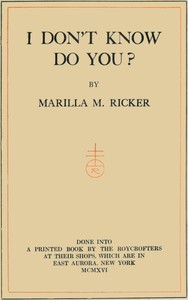
At Folio's default of ten pages a day, you finish I don't know, do you? in about 14 days — roughly 8 minutes of reading each morning.
The opening
the first pages of I don't know, do you?, free
There is in the city of Boston a memorial building to Thomas Paine. This Paine Memorial was finished and dedicated forty-two years ago. It is the finest monument to Thomas Paine on the earth.
_For twenty years Ralph Washburn Chainey has been the Manager of this building and the Treasurer of the Paine Memorial Corporation. Under his wise and prudent management the building was freed from debt, and today it is a monument to the energy and devotion of its Manager as much as to the genius and labors of Thomas Paine._
_Ralph Washburn Chainey is only forty-two, and as great an example of thrift as Ben Franklin was. Very early in life he acquired the habit of thrift--which is the basis of all virtues. He learned early that time was money and he is always at work. He is not only able to take care of himself, but he can and does take care of others. He is sufficient unto himself, and when one is right with himself he is right with all the world. I have known him intimately for more than a quarter of a century, and if he has faults I have yet to learn what they are._
In appreciation, therefore, of his great service to the cause of Freethought, I dedicate this volume to
RALPH WASHBURN CHAINEY
--Marilla M. Ricker.
Dover, New Hampshire December, Nineteen Hundred Fifteen
As man advances, as his intellect enlarges, as his knowledge increases, as his ideals become nobler, the Bibles and creeds will lose their authority, the miraculous will be classed with the impossible, and the idea of special providence will be discarded. Thousands of religions have perished, innumerable gods have died, and why should the religion of our time be exempt from the common fate?
--Robert Ingersoll.
CONTENTS
FOREWORD 7
CREEDS AGAINST CIVILIZATION 11
WHAT I KNOW ABOUT SOME CHURCHES, AND WHY I AM AN AGNOSTIC 33
A LETTER AND THE REJOINDER 55
THE HOLY GHOST 65
HOW CAN WE "TAKE" CHRIST? 71
COLONEL ROBERT G. INGERSOLL 81
MARK TWAIN'S BEST THOUGHT 85
AN IRRELIGIOUS DISCOURSE ON RELIGION 89
DECAY OF CHRISTIAN MORALITY 107
I know of no other book that so fully teaches the subjection and degradation of woman as the Bible.
--Elizabeth Cady Stanton.
That God had to come to earth to find a mother for his son reveals the poverty of Heaven.
CREEDS AGAINST CIVILIZATION
Any system of religion that shocks the mind of a child can not be a true system.
--Thomas Paine.
Hell is a place invented by priests and parsons for the sake of being supported.
[Illustration]
CREEDS AGAINST CIVILIZATION
One hundred fifty years ago, there was not a single white man in what is now Kentucky, Ohio, Indiana and Illinois. What is now the most flourishing part of the United States was then as little known as the country in the heart of Africa itself. It was not until Seventeen Hundred Seventy-six that Boone left his home in North Carolina to become the first settler in Kentucky; and the pioneers of Ohio did not settle that territory until twenty years later.
Canada belonged to France one hundred fifty-three years ago, and Washington was a modest Virginia Colonel, and the United States was the most loyal part of the British Empire, and scarcely a speck on the political horizon indicated the struggle that in a few years was to lay the foundation of the greatest republic in the world.
One hundred fifty years ago there were but four small newspapers in America; steam-engines had not been imagined; and locomotives and railroads, and telegraphs and postal cards, and friction-matches, and revolvers and percussion-caps, and breechloading-guns and Mauser rifles, and stoves and furnaces, and gas and electricity and rubber shoes, and Spaulding's glue, and sewing-machines and anthracite coal, and photographs, and kerosene-oil, free schools, and spring-beds and hair-mattresses, and lever-watches and greenbacks were unknown. The spinning-wheel was in almost every family, and clothing was spun and woven and made up in the family; and the printing-press was a cumbrous machine worked by hand.
Keep going from exactly here — Folio remembers your place and serves the next portion tomorrow.
continue reading I don't know, do you?About this free edition
I don't know, do you? by Marilla M. Ricker (1840-1920) is free to read in full. Folio serves it in daily portions you can actually finish, tracks your streak and reading position across devices, and reads every page aloud with a built-in narrator. The text comes from Project Gutenberg.
More like I don't know, do you?
Meditations
Folio
Meditations
Marcus Aurelius
The Enchiridion
Epictetus

Thus Spake Zarathustra
Friedrich Nietzsche
Beyond Good and Evil
Folio
Beyond Good and Evil
Friedrich Nietzsche
The Genealogy of Morals
Folio
The Genealogy of Morals
Friedrich Nietzsche
The Republic
Folio
The Republic
Plato
Apology
Folio
Apology
Plato
Crito
Folio
Crito
Plato