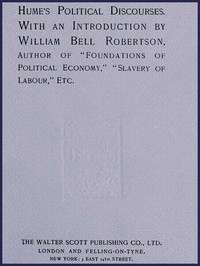
Hume's Political Discourses
free to read
length
103,969 words
a few pages a day
~8 min
finished in
55 days
full read
7h 13m
At Folio's default of ten pages a day, you finish Hume's Political Discourses in about 55 days — roughly 8 minutes of reading each morning.
The opening
the first pages of Hume's Political Discourses, free
E-text prepared by RichardW and the Online Distributed Proofreading Team (http://www.pgdp.net) from page images generously made available by Internet Archive (https://archive.org)
Note: Images of the original pages are available through Internet Archive. See https://archive.org/details/humespolitical00humeuoft
Some characters might not display properly in this UTF-8 text file (e.g., empty squares). If so, the reader should consult the original page images noted above.
Transcriber’s note:
Text enclosed by underscores is in italics (italics).
Original small capitals are now uppercase (but some small capital styling has been discarded).
Footnotes have been relabeled 1–117, converted to endnotes, and moved to the ends of the relevant chapters.
The Scott Library.
HUME’S POLITICAL DISCOURSES.
⁂ For Full List of the Volumes in This Series, See Catalogue at End of Book.
HUME’S POLITICAL DISCOURSES.
With an Introduction by William Bell Robertson, Author of “Foundations of Political Economy,” “Slavery of Labour,” Etc.
The Walter Scott Publishing Co., Ltd. London and Felling-on-Tyne. New York: 3 East 14th Street.
CONTENTS.
Introduction vii
Of Commerce 1
Of Refinement in the Arts 15
Of Money 27
Of Interest 39
Of the Balance of Trade 51
Of the Jealousy of Trade 67
Of the Balance of Power 71
Of Taxes 78
Of Public Credit 83
Of some Remarkable Customs 98
Of the Populousness of Ancient Nations 106
Of the Original Contract 174
Of Passive Obedience 192
Of the Coalition of Parties 196
Of the Protestant Succession 203
Idea of a Perfect Commonwealth 214
That Politics may be Reduced to a Science 229
Of the First Principles of Government 243
Of Political Society 247
Alphabetical Arrangement of Authorities cited by Hume 253
INTRODUCTION.
Regretting the meagre records of the life of Adam Smith, the Right Hon. R. B. Haldane, M.P.,[1] remarks:—“We think of him, in the main, and we think of him rightly, as the bosom friend of David Hume” (b. 1711, d. 1777). Naturally, incidents in the life of a philosopher are neither numerous nor stirring. It is unreasonable to expect them, and such stories as are handed down regarding great thinkers are best not to be accepted unreservedly. I leave Hume, therefore, to present his own picture as drawn in My own Life—the picture he wished posterity to have—which consequently follows this introduction, and is itself followed by Adam Smith’s celebrated letter to Mr. Strahan, Hume’s publisher, giving an account of Hume’s death.
It is chiefly as a political economist that Hume concerns us here, as it is in the Political Discourses, first published in 1752, his economic principles are set forth. What the reader may expect to find in these Discourses I prefer to let writers of renown tell. Thus Lord Brougham—
“Of the Political Discourses it would be difficult to speak in terms of too great commendation. They combine almost every excellence which can belong to such a performance. The reasoning is clear, and unencumbered with more words or more illustrations than are necessary for bringing out the doctrines. The learning is extensive, accurate, and profound, not only as to systems of philosophy, but as to history, whether modern or ancient. . . . The great merit, however, of these Discourses is their originality, and the new system of politics and political economy which they unfold. Mr. Hume is, beyond all doubt, the author of the modern doctrines which now rule the world of science, which are to a great extent the guide of practical statesmen, and are only prevented from being applied in their fullest extent to the affairs of nations by the clashing interests and the ignorant prejudices of certain powerful classes.”
Keep going from exactly here — Folio remembers your place and serves the next portion tomorrow.
continue reading Hume's Political DiscoursesAbout this free edition
Hume's Political Discourses by David Hume (1711-1776) is free to read in full. Folio serves it in daily portions you can actually finish, tracks your streak and reading position across devices, and reads every page aloud with a built-in narrator. The text comes from Project Gutenberg.
More like Hume's Political Discourses
An Enquiry Concerning Human Understanding
Folio
An Enquiry Concerning Human Understanding
David Hume
A Treatise of Human Nature
Folio
A Treatise of Human Nature
David Hume
An Enquiry Concerning the Principles of Morals
Folio
An Enquiry Concerning the Principles of Morals
David Hume
Dialogues Concerning Natural Religion
Folio
Dialogues Concerning Natural Religion
David Hume
Hume's Essays
Folio
Hume's Essays
David Hume
Meditations
Folio
Meditations
Marcus Aurelius
The Enchiridion
Epictetus
Thus Spake Zarathustra
Friedrich Nietzsche