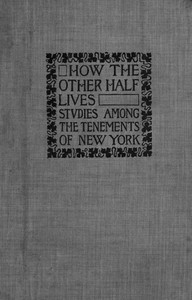
How the Other Half Lives
first published 1890 · free to read
length
81,050 words
a few pages a day
~8 min
finished in
43 days
full read
5h 38m
At Folio's default of ten pages a day, you finish How the Other Half Lives in about 43 days — roughly 8 minutes of reading each morning.
The opening
the first pages of How the Other Half Lives, free
"With gates of silver and bars of gold Ye have fenced my sheep from their father's fold; I have heard the dropping of their tears In heaven these eighteen hundred years."
"O Lord and Master, not ours the guilt, We build but as our fathers built; Behold thine images, how they stand, Sovereign and sole, through all our land."
Then Christ sought out an artisan, A low-browed, stunted, haggard man, And a motherless girl, whose fingers thin Pushed from her faintly want and sin.
These set he in the midst of them, And as they drew back their garment-hem, For fear of defilement, "Lo, here," said he, "The images ye have made of me!"
--JAMES RUSSELL LOWELL.
HOW THE OTHER HALF LIVES.
INTRODUCTION.
Long ago it was said that "one half of the world does not know how the other half lives." That was true then. It did not know because it did not care. The half that was on top cared little for the struggles, and less for the fate of those who were underneath, so long as it was able to hold them there and keep its own seat. There came a time when the discomfort and crowding below were so great, and the consequent upheavals so violent, that it was no longer an easy thing to do, and then the upper half fell to inquiring what was the matter. Information on the subject has been accumulating rapidly since, and the whole world has had its hands full answering for its old ignorance.
In New York, the youngest of the world's great cities, that time came later than elsewhere, because the crowding had not been so great. There were those who believed that it would never come; but their hopes were vain. Greed and reckless selfishness wrought like results here as in the cities of older lands. "When the great riot occurred in 1863," so reads the testimony of the Secretary of the Prison Association of New York before a legislative committee appointed to investigate causes of the increase of crime in the State twenty-five years ago, "every hiding-place and nursery of crime discovered itself by immediate and active participation in the operations of the mob. Those very places and domiciles, and all that are like them, are to-day nurseries of crime, and of the vices and disorderly courses which lead to crime. By far the largest part--eighty per cent. at least--of crimes against property and against the person are perpetrated by individuals who have either lost connection with home life, or never had any, or whose homes had ceased to be sufficiently separate, decent, and desirable to afford what are regarded as ordinary wholesome influences of home and family.... The younger criminals seem to come almost exclusively from the worst tenement house districts, that is, when traced back to the very places where they had their homes in the city here." Of one thing New York made sure at that early stage of the inquiry: the boundary line of the Other Half lies through the tenements.
It is ten years and over, now, since that line divided New York's population evenly. To-day three-fourths of its people live in the tenements, and the nineteenth century drift of the population to the cities is sending ever-increasing multitudes to crowd them. The fifteen thousand tenant houses that were the despair of the sanitarian in the past generation have swelled into thirty-seven thousand, and more than twelve hundred thousand persons call them home. The one way out he saw--rapid transit to the suburbs--has brought no relief. We know now that there is no way out; that the "system" that was the evil offspring of public neglect and private greed has come to stay, a storm-centre forever of our civilization. Nothing is left but to make the best of a bad bargain.
Keep going from exactly here — Folio remembers your place and serves the next portion tomorrow.
continue reading How the Other Half LivesAbout this free edition
How the Other Half Lives by Jacob A. Riis (1849-1914) is free to read in full. Folio serves it in daily portions you can actually finish, tracks your streak and reading position across devices, and reads every page aloud with a built-in narrator. The text comes from Project Gutenberg.
More like How the Other Half Lives
The Making of an American
Folio
The Making of an American
Jacob A. Riis
Hero Tales of the Far North
Jacob A. Riis
The Battle with the Slum
Folio
The Battle with the Slum
Jacob A. Riis
The Children of the Poor
Folio
The Children of the Poor
Jacob A. Riis

The Autobiography of Benjamin Franklin
Benjamin Franklin
Narrative of the Life of Frederick Douglass
Folio
Narrative of the Life of Frederick Douglass
Frederick Douglass
My Bondage and My Freedom
Folio
My Bondage and My Freedom
Frederick Douglass
The Story of My Life
Folio
The Story of My Life
Helen Keller