length
233,726 words
a few pages a day
~8 min
finished in
124 days
full read
16h 14m
At Folio's default of ten pages a day, you finish History of scientific ideas in about 124 days — roughly 8 minutes of reading each morning.
The opening
the first pages of History of scientific ideas, free
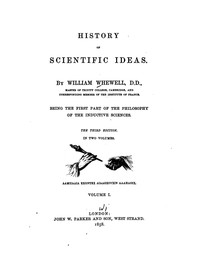
THE Chapters now offered to the Reader were formerly published as a portion of The Philosophy of the Inductive Sciences, founded upon their History: but the nature and subject of these Chapters are more exactly described by the present title, The History of Scientific Ideas. For this part of the work is mainly historical, and was, in fact, collected from the body of scientific literature, at the same time that the History of the Inductive Sciences was so collected. The present work contains the history of Science so far as it depends on Ideas; the former work contains the same history so far as it is derived from Observation. The leading features in that were Theories inferred from Facts; the leading features of this are Discussions of Theories tending to make them consistent with the conditions of human thought.
The Ideas of which the History is here given are mainly the following: Space, Time, Number, Motion, Cause, Force, Matter, Medium, Intensity, Scale, Polarity, Element, Affinity, Substance, Atom, Symmetry, Likeness, Natural Classes, Species, Life, Function, Vital Forces, Final {vi} Causes, Historical Causation, Catastrophe and Uniformity, First Cause.
The controversies to which the exact fixation of these Ideas and their properties have given occasion form a large and essential part of the History of Science: but they also form an important part of the Philosophy of Science, for no Philosophy of Science can be complete which does not solve the difficulties, antitheses, and paradoxes on which such controversies have turned. I have given a survey of such controversies, generally carried from their earliest origin to their latest aspect; and have stated what appeared to me the best solution of each problem. This has necessarily involved me in much thorny metaphysics; but such metaphysics is a necessary part of the progress of Science. The human mind deriving its knowledge of Truth from the observation of nature, cannot evade the task of determining at every step how Truth is consistent with itself. This is the Metaphysics of Progressive Knowledge, and this is the matter of this present History.
Of the remaining part of what was formerly published as the Philosophy of the Inductive Sciences, an additional part, described in the Introduction to the present work, will shortly be published.
TRINITY LODGE, May 24, 1858.
ERRATUM, p. 157, l. 11 from top, for sciences read science.
CONTENTS OF THE FIRST VOLUME.
PAGE PREFACE v
PART I. OF IDEAS.
INTRODUCTION 3
BOOK I.
OF IDEAS IN GENERAL.
CHAP. I. OF THE FUNDAMENTAL ANTITHESIS OF PHILOSOPHY 23
Sect. 1. Thoughts and Things -- 2. Necessary and Experiential Truths 25 3. Deduction and Induction 27 4. Theories and Facts 29 5. Ideas and Sensations 30 6. Reflexion and Sensation 33 7. Subjective and Objective 35 8. Matter and Form 38 9. Man the Interpreter of Nature 41 10. The Fundamental Antithesis is inseparable 43 11. Successive Generalization 49 {viii}
CHAP. II. OF TECHNICAL TERMS 54
Art. 1. Examples. 2. Use of Terms.
CHAP. III. OF NECESSARY TRUTHS 57
Art. 1. The two Elements of Knowledge, 2. Shown by necessary Truths. 3. Examples of necessary Truths in numbers. 4. The opposite cannot be distinctly conceived. 5. Other Examples. 6. Universal Truths.
CHAP. IV. OF EXPERIENCE 65
Art. 1. Experience cannot prove necessary Truths, 2. Except when aided by Ideas.
CHAP. V. OF THE GROUNDS OF NECESSARY TRUTHS 69
Keep going from exactly here — Folio remembers your place and serves the next portion tomorrow.
continue reading History of scientific ideasAbout this free edition
History of scientific ideas by William Whewell (1794-1866) is free to read in full. Folio serves it in daily portions you can actually finish, tracks your streak and reading position across devices, and reads every page aloud with a built-in narrator. The text comes from Project Gutenberg.
More like History of scientific ideas
The Plurality of Worlds
Folio
The Plurality of Worlds
William Whewell
Novum organon renovatum
William Whewell
Meditations
Folio
Meditations
Marcus Aurelius
The Enchiridion
Epictetus

Thus Spake Zarathustra
Friedrich Nietzsche
Beyond Good and Evil
Folio
Beyond Good and Evil
Friedrich Nietzsche
The Genealogy of Morals
Folio
The Genealogy of Morals
Friedrich Nietzsche
The Republic
Folio
The Republic
Plato