length
21,312 words
a few pages a day
~8 min
finished in
12 days
full read
1h 29m
At Folio's default of ten pages a day, you finish Herder's conception of "das Volk" in about 12 days — roughly 8 minutes of reading each morning.
The opening
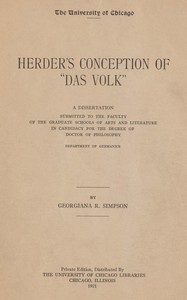
the first pages of Herder's conception of "das Volk", free
I wish to express my sincere thanks to all my Professors, but especially to Professors Starr W. Cutting, Martin Schütze, and Francis A. Wood, under whom the major portion of my work in the Graduate School has been pursued.
This particular study, however, is the outcome of interest awakened by Professor Schütze while I was a member of his seminars.
I owe a special debt of gratitude to him, not only for his guidance in this endeavor, but for the inspiration and encouragement which has come to me from the very beginning of my work under him.
GEORGIANA R. SIMPSON
CONTENTS
CHAPTER PAGE
I. SEMASIOLOGY OF THE WORD, Volk—THE IDEA IN OTHER WORDS 1
II. CONCEPTIONS OF Volk AS SEEN IN HERDER’S USE OF THE TERM 4
III. CONCEPTIONS OF Volk AS GATHERED FROM HERDER’S COLLECTION OF Volkslieder 15
IV. CONCEPTIONS OF Volk IN HERDER’S DISCUSSION OF “OSSIAN’S PEOPLE” AND THE ANCIENT HEBREWS 22
V. FOUNDATIONS OF INDIVIDUALITY AND PERSONALITY IN HERDER 31
VI. EIGHTEENTH-CENTURY THOUGHT IN HERDER’S CONCEPTION OF Das Volk 36
VII. CONCLUSION 54
BIBLIOGRAPHY 58
CHAPTER I
SEMASIOLOGY OF VOLK—THE IDEA IN OTHER WORDS
Before going directly to the main discussion of our theme, a background is sought in a brief semasiological study of the word Volk. The word is widespread in the Germanic languages; Gothic, however, offers no examples. Among the earliest recorded Germanic forms are those in Old English and in Old High German. Old English folc meant people, common people, multitude, a people, tribe, family, army:
“He sloh folces Denigea fyftyne men”—Beowulf.
“Folces hyrde”—Beowulf.
It was particularly used originally of a crowd of people. Skeat’s Etymological Dictionary suggests the possibility of its being related to both flock and full.
Old High German folc meant people, body of warriors, servants, crowd, mass. The oldest meaning here suggests forces of war: dhazs himiliscâ folc.
The word occurs in Old Frisian as folk; in Old Saxon, folc; and in Old Norse, folk; with meanings equivalent to those found in Old High German and Old English.
Kluge’s Etymological Dictionary says that the meaning “division of an army” seems to be the fundamental meaning of the family group, from which Lithuanian pulkas, heap mass, Old Slavonic plŭkŭ, host of war, are borrowed forms.
In Middle English the word took on the additional meaning of an aggregation of people in relation to a superior; e.g., God, a king, or priest; further it began to mean also the vulgar or lower classes, this use easily rising out of the meaning “mass” or “the many.” Such expressions occur as beboden waes Godes folce, Folkes Mass Book.
In Middle High German the meaning was people, hosts of war, army, servants, subjects, multitude: er das Volk gewan (Gudrun, 1162, 2).
In Modern English the word is chiefly colloquial, being superseded in more formal use by “people.”
In numerous combinations (following German precedent) it has the sense of pertaining to, current among, or existing among the masses of the people or the common people. Such expressions as folk-belief, folk-custom, folk-literature, folk-name, folk-song, and folk-speech are prevalent.
Modern High German has retained the word with nearly all of its primitive meanings: die schottischen Völker empören sich und drohen abzuziehen;[1] Mein Volk zu mindern;[2] Was rennt das Volk?;[3] du weisst, wir alten fahren, und ihr junges Volk reitet;[4] den Teufel spürt das Völkchen nie.[5]
Keep going from exactly here — Folio remembers your place and serves the next portion tomorrow.
continue reading Herder's conception of "das Volk"About this free edition
Herder's conception of "das Volk" by Georgiana Rose Simpson (1865-1944) is free to read in full. Folio serves it in daily portions you can actually finish, tracks your streak and reading position across devices, and reads every page aloud with a built-in narrator. The text comes from Project Gutenberg.
More like Herder's conception of "das Volk"
Meditations
Folio
Meditations
Marcus Aurelius
The Enchiridion
Epictetus
Thus Spake Zarathustra
Friedrich Nietzsche
Beyond Good and Evil
Folio
Beyond Good and Evil
Friedrich Nietzsche
The Genealogy of Morals
Folio
The Genealogy of Morals
Friedrich Nietzsche
The Republic
Folio
The Republic
Plato
Apology
Folio
Apology
Plato
Crito
Folio
Crito
Plato