length
13,492 words
a few pages a day
~8 min
finished in
8 days
full read
56 min
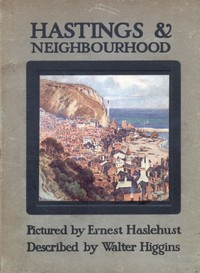
At Folio's default of ten pages a day, you finish Hastings and Neighbourhood in about 8 days — roughly 8 minutes of reading each morning.
The opening
the first pages of Hastings and Neighbourhood, free
Between the hills and the sea it lies--the most romantic province in this England of ours. Scarcely a place in it seems to belong to this present: from end to end it is built up almost entirely of memories. The very repetition of the names--Rye, Winchelsea, Pevensey, Battle, Bodiam, Hurstmonceux--conjures up the past in all its magnificence and all its sadness. Nowhere in so small a space shall you find so many monuments to the greatness of England's former days, to the imperishable glory of her people; nowhere in our coasts shall you find a stretch of land so crowded with the ghosts of dead men and dead empires.
If for this alone, the territory, no matter how ill-favoured and unattractive, would be worth visiting and revisiting. But there is yet another call--that of the intrinsic beauty of the country-side. And the call here is insistent. Hills and the sea; great folding downs and little valleys dropping fatness; immense stretches of lonely marsh and the nestling charms of copse-hidden villages; gentlest of streams slipping lazily through peacefullest of domains; wildest of breakers spending themselves at the base of steep tawny cliffs. Thus is the land compact. One is always reminded of a passage from Mark Twain: "That beauty which is England is alone; it has no duplicate. It is made up of very simple details, just grass, and trees, and shrubs, and roads, and hedges, and gardens, and houses, and churches, and castles, and here and there a ruin, and over all a mellow dreamland of history. But its beauty is incomparable and all its own." And search where you will--north, south, east, west--nowhere can you come upon a spot to which these words might with greater fitness be applied; for this sequestered little area is the microcosm of England.
Despite its wilderness of bricks and mortar, Hastings itself is, under certain conditions, a place by no means unbeautiful. Possibly it is from the sea that it appears in happiest mood. One can take a boat on a high summer's morning, when the sun is shining gaily on its steep grass-capped cliffs, its fragment of castle ruin, its red and blue-grey roofs, when the sea is mazing away into every tint of emerald and sapphire. Then it is a place fair to behold and pleasing to remember. Or one can clamber to the top of the castle hill, and, Janus-like, comprehend the town in its entirety--eastwards the old town and the Past; westwards the modern watering-place and the Future. Then it is a place for soliloquy and moralizing.
Of the very early history of Hastings we know practically nothing, save that it seems to have been for many years a place apart. Shut off from the west by the invious flats of Pevensey, then one vast network of lagoons: from the east by the greater marsh of Romney; secluded on the north by the grey mystery of Andredesweald, which in those days came as far south as the top of Fairlight Hill, the people experienced a certain splendid isolation. So much so, in fact, that in the early records it was quite customary to refer to them as a race apart, as distinct as either of their nearest neighbours, the Jutes of Kent or the Saxons of Sussex. "And all Kent and Sussex and Hastings" was a phrase running easily from the pens of ancient chroniclers.
No one knows their origin. There was a tribe of Hastengi dwelling on the seaboard between the Elbe and what is now Denmark, having as a chieftain one Haesten, a piratical Dane, with whose name that of the town is often linked (erroneously, say some). In all probability, following on some raid rather more extensive and successful than usual, a party of these Hastengi came by this district as an allotment, and chose to settle here, bringing over their families and herds. Maybe thus the town was originated.
One of their earliest tasks, doubtless, was the construction of a stronghold, either the strengthening of an existing British earthwork or the formation of an entirely new one. The conditions of life demanded that they should possess such a fortification, a place which should be at once the residence of the chief and a refuge for the people in time of danger. And thus it happened that ere long there came into existence the Hastinga-ceastre, mention of which is made in the Anglo-Saxon Chronicle in 1050: "A little before that [the murder of Beorn by Sweyn] the men of Hastinga-ceastre and thereabouts won two of his ships with two of their ships and slew all the men and brought the ships to Sandwich to the King". But prior to 1050 the town must have attained to a considerable maritime strength and commercial eminence, for in 924 Athelstan founded a mint here. The site of this successful Saxon town and harbour is a matter of conjecture; only the hurrying sea knows where it lies.
Keep going from exactly here — Folio remembers your place and serves the next portion tomorrow.
continue reading Hastings and NeighbourhoodAbout this free edition
Hastings and Neighbourhood by Walter Higgins is free to read in full. Folio serves it in daily portions you can actually finish, tracks your streak and reading position across devices, and reads every page aloud with a built-in narrator. The text comes from Project Gutenberg.
More like Hastings and Neighbourhood
The History of the Peloponnesian War
Folio
The History of the Peloponnesian War
Thucydides
The History of Herodotus
Folio
The History of Herodotus
Herodotus
The Gallic Wars
Folio
The Gallic Wars
Julius Caesar
Anabasis
Folio
Anabasis
Xenophon
The Lives of the Twelve Caesars
Folio
The Lives of the Twelve Caesars
Suetonius
Germania
Folio
Germania
Tacitus

The History of the Decline and Fall of the Roman Empire
Edward Gibbon

The Travels of Marco Polo
Marco Polo