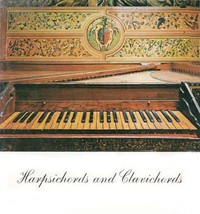
Harpsichords and Clavichords
free to read
length
3,043 words
a few pages a day
~8 min
finished in
2 days
full read
13 min
At Folio's default of ten pages a day, you finish Harpsichords and Clavichords in about 2 days — roughly 8 minutes of reading each morning.
The opening
the first pages of Harpsichords and Clavichords, free
The harpsichord and the clavichord represent the two most important types of stringed keyboard instruments used from the 15th through the 18th centuries. By the 19th century, the piano had become the most important domestic keyboard instrument.
In this booklet are described a few of the restored Smithsonian harpsichords and clavichords that are occasionally on exhibit in the Hall of Musical Instruments or in use in the series of concerts sponsored by the Division of Musical Instruments. Models showing how the sound is produced on these instruments are also on exhibit.
A complete list of the keyboard collection is found in A Checklist of Keyboard Instruments at the Smithsonian Institution (Washington, 1967), which is available from the Division of Musical Instruments, Smithsonian Institution, Washington, D.C. 20560.
Harpsichords
The harpsichord and its smaller relatives, the virginal and the spinet, have strings that are plucked. The harpsichord is wing-shaped, most virginals and spinets are either rectangular or polygonal.
When the harpsichord key is pressed, a wooden jack is raised so that a quill or leather plectrum inserted into the jack tongue plucks the string. When the key is released, the jack falls back into place, the pivoted tongue allowing the plectrum to pass the string without plucking it. A felt damper (inserted in a slit at the top of the jack) touches the string to stop the sound.
Figure 1 shows the jack arrangement in an 18th century English spinet. The second jack from the left on the front row has been raised so that its quill is just about to pluck the string. Note that the quill has lifted the string above its rest position.
Inherent in the design of a harpsichord is the limitation of dynamic nuance. The sound of a harpsichord is not greatly altered by increasing or lessening the impact of fingers on the keys. Rather, the dynamic level and quality of sound can be changed by varying the number of strings plucked (many harpsichords have three sets of strings: two sets tuned in unison [8'] and a third tuned an octave higher [4']), by varying the location of the plucking point, and by muting the strings with felt or leather pads.
The tone of a keyboard instrument is also affected by its general outline, the material and thickness of the soundboard, the length and material of the strings, and the type of case construction. The case must be strong enough to counteract the tension of the strings and yet light enough to allow the sound to resonate.
[Illustration: 1. Harpsichord action. Photo: Robert Lautman.]
Among the Smithsonian's extensive keyboard collection are fine examples of harpsichords that represent several of the major national trends in harpsichord building: the Flemish, Italian, English, and French.
Flemish Harpsichords
Antwerp was the harpsichord-making center of northern Europe during the 16th and 17th centuries. The earliest examples of harpsichords had only one keyboard and one or two sets of 8' strings. The progressive Flemish makers added a second keyboard and another set of strings, tuned an octave higher than the others, which allowed a wider range in pitch and more variety in sound. Later French and English harpsichords were largely derived from the Flemish style.
Virginal, 1620; made by Andreas Ruckers, Antwerp One manual; Range C/E-c^3 (apparent); 1×8'
Keep going from exactly here — Folio remembers your place and serves the next portion tomorrow.
continue reading Harpsichords and ClavichordsAbout this free edition
Harpsichords and Clavichords by Cynthia A. Hoover is free to read in full. Folio serves it in daily portions you can actually finish, tracks your streak and reading position across devices, and reads every page aloud with a built-in narrator. The text comes from Project Gutenberg.
More like Harpsichords and Clavichords
The History of the Peloponnesian War
Folio
The History of the Peloponnesian War
Thucydides
The History of Herodotus
Folio
The History of Herodotus
Herodotus
The Gallic Wars
Folio
The Gallic Wars
Julius Caesar
Anabasis
Folio
Anabasis
Xenophon
The Lives of the Twelve Caesars
Folio
The Lives of the Twelve Caesars
Suetonius
Germania
Folio
Germania
Tacitus
The History of the Decline and Fall of the Roman Empire
Edward Gibbon

The Travels of Marco Polo
Marco Polo