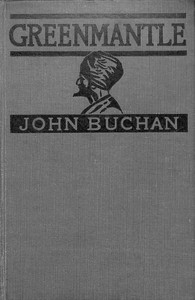
Greenmantle
first published 1916 · free to read
length
98,581 words
a few pages a day
~8 min
finished in
52 days
full read
6h 51m
At Folio's default of ten pages a day, you finish Greenmantle in about 52 days — roughly 8 minutes of reading each morning.
The opening
the first pages of Greenmantle, free
During the past year, in the intervals of an active life, I have amused myself with constructing this tale. It has been scribbled in every kind of odd place and moment—in England and abroad, during long journeys, in half-hours between graver tasks; and it bears, I fear, the mark of its gipsy begetting. But it has amused me to write, and I shall be well repaid if it amuses you—and a few others—to read.
Let no man or woman call its events improbable. The war has driven that word from our vocabulary, and melodrama has become the prosiest realism. Things unimagined before happen daily to our friends by sea and land. The one chance in a thousand is habitually taken, and as often as not succeeds. Coincidence, like some new Briareus, stretches a hundred long arms hourly across the earth. Some day, when the full history is written—sober history with ample documents—the poor romancer will give up business and fall to reading Miss Austen in a hermitage.
The characters of the tale, if you think hard, you will recall. Sandy you know well. That great spirit was last heard of at Basra, where he occupies the post that once was Harry Bullivant’s. Richard Hannay is where he longed to be, commanding his battalion on the ugliest bit of front in the West. Mr John S. Blenkiron, full of honour and wholly cured of dyspepsia, has returned to the States, after vainly endeavouring to take Peter with him. As for Peter, he has attained the height of his ambition. He has shaved his beard and joined the Flying Corps.
CHAPTER I. A Mission is Proposed
I had just finished breakfast and was filling my pipe when I got Bullivant’s telegram. It was at Furling, the big country house in Hampshire where I had come to convalesce after Loos, and Sandy, who was in the same case, was hunting for the marmalade. I flung him the flimsy with the blue strip pasted down on it, and he whistled.
“Hullo, Dick, you’ve got the battalion. Or maybe it’s a staff billet. You’ll be a blighted brass-hat, coming it heavy over the hard-working regimental officer. And to think of the language you’ve wasted on brass-hats in your time!”
I sat and thought for a bit, for the name “Bullivant’ carried me back eighteen months to the hot summer before the war. I had not seen the man since, though I had read about him in the papers. For more than a year I had been a busy battalion officer, with no other thought than to hammer a lot of raw stuff into good soldiers. I had succeeded pretty well, and there was no prouder man on earth than Richard Hannay when he took his Lennox Highlanders over the parapets on that glorious and bloody 25th day of September. Loos was no picnic, and we had had some ugly bits of scrapping before that, but the worst bit of the campaign I had seen was a tea-party to the show I had been in with Bullivant before the war started. [Major Hannay’s narrative of this affair has been published under the title of The Thirty-nine Steps.]
The sight of his name on a telegram form seemed to change all my outlook on life. I had been hoping for the command of the battalion, and looking forward to being in at the finish with Brother Boche. But this message jerked my thoughts on to a new road. There might be other things in the war than straightforward fighting. Why on earth should the Foreign Office want to see an obscure Major of the New Army, and want to see him in double-quick time?
“I’m going up to town by the ten train,” I announced; “I’ll be back in time for dinner.”
“Try my tailor,” said Sandy. “He’s got a very nice taste in red tabs. You can use my name.”
An idea struck me. “You’re pretty well all right now. If I wire for you, will you pack your own kit and mine and join me?”
“Right-o! I’ll accept a job on your staff if they give you a corps. If so be as you come down tonight, be a good chap and bring a barrel of oysters from Sweeting’s.”
I travelled up to London in a regular November drizzle, which cleared up about Wimbledon to watery sunshine. I never could stand London during the war. It seemed to have lost its bearings and broken out into all manner of badges and uniforms which did not fit in with my notion of it. One felt the war more in its streets than in the field, or rather one felt the confusion of war without feeling the purpose. I dare say it was all right; but since August 1914 I never spent a day in town without coming home depressed to my boots.
Keep going from exactly here — Folio remembers your place and serves the next portion tomorrow.
continue reading GreenmantleAbout this free edition
Greenmantle by John Buchan (1875-1940) is free to read in full. Folio serves it in daily portions you can actually finish, tracks your streak and reading position across devices, and reads every page aloud with a built-in narrator. The text comes from Project Gutenberg.
More like Greenmantle
The Thirty-Nine Steps
John Buchan

The Power-House
John Buchan
Mr. Standfast
John Buchan
Prester John
Folio
Prester John
John Buchan
John Burnet of Barns
Folio
John Burnet of Barns
John Buchan
The Path of the King
Folio
The Path of the King
John Buchan
Huntingtower
Folio
Huntingtower
John Buchan
Salute to Adventurers
Folio
Salute to Adventurers
John Buchan