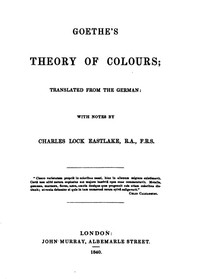
Goethe's Theory of Colours
by Johann Wolfgang von Goethe (1749-1832)
first published 1810 · free to read
length
94,632 words
a few pages a day
~8 min
finished in
50 days
full read
6h 34m
At Folio's default of ten pages a day, you finish Goethe's Theory of Colours in about 50 days — roughly 8 minutes of reading each morning.
The opening
the first pages of Goethe's Theory of Colours, free
English writers who have spoken of Goethe's "Doctrine of Colours,"[1] have generally confined their remarks to those parts of the work in which he has undertaken to account for the colours of the prismatic spectrum, and of refraction altogether, on principles different from the received theory of Newton. The less questionable merits of the treatise consisting of a well-arranged mass of observations and experiments, many of which are important and interesting, have thus been in a great measure overlooked. The translator, aware of the opposition which the theoretical views alluded to have met with, intended at first to make a selection of such of the experiments as seem more directly applicable to the theory and practice of painting. Finding, however, that the alterations this would have involved would have been incompatible with a clear and connected view of the author's statements, he preferred giving the theory itself entire, reflecting, at the same time, that some scientific readers may be curious to hear the author speak for himself even on the points at issue.
In reviewing the history and progress of his opinions and researches, Goethe tells us that he first submitted his views to the public in two short essays entitled "Contributions to Optics." Among the circumstances which he supposes were unfavourable to him on that occasion, he mentions the choice of his title, observing that by a reference to optics he must have appeared to make pretensions to a knowledge of mathematics, a science with which he admits he was very imperfectly acquainted. Another cause to which he attributes the severe treatment he experienced, was his having ventured so openly to question the truth of the established theory: but this last provocation could not be owing to mere inadvertence on his part; indeed the larger work, in which he alludes to these circumstances, is still more remarkable for the violence of his objections to the Newtonian doctrine.
There can be no doubt, however, that much of the opposition Goethe met with was to be attributed to the manner as well as to the substance of his statements. Had he contented himself with merely detailing his experiments and showing their application to the laws of chromatic harmony, leaving it to others to reconcile them as they could with the pre-established system, or even to doubt in consequence, the truth of some of the Newtonian conclusions, he would have enjoyed the credit he deserved for the accuracy and the utility of his investigations. As it was, the uncompromising expression of his convictions only exposed him to the resentment or silent neglect of a great portion of the scientific world, so that for a time he could not even obtain a fair hearing for the less objectionable or rather highly valuable communications contained in his book. A specimen of his manner of alluding to the Newtonian theory will be seen in the preface.
It was quite natural that this spirit should call forth a somewhat vindictive feeling, and with it not a little uncandid as well as unsparing criticism. "The Doctrine of Colours" met with this reception in Germany long before it was noticed in England, where a milder and fairer treatment could hardly be expected, especially at a time when, owing perhaps to the limited intercourse with the continent, German literature was far less popular than it is at present. This last fact, it is true, can be of little importance in the present instance, for although the change of opinion with regard to the genius of an enlightened nation must be acknowledged to be beneficial, it is to be hoped there is no fashion in science, and the translator begs to state once for all, that in advocating the neglected merits of the "Doctrine of Colours," he is far from undertaking to defend its imputed errors. Sufficient time has, however, now elapsed since the publication of this work (in 1810) to allow a calmer and more candid examination of its claims. In this more pleasing task Germany has again for some time led the way, and many scientific investigators have followed up the hints and observations of Goethe with a due acknowledgment of the acuteness of his views.[2]
Keep going from exactly here — Folio remembers your place and serves the next portion tomorrow.
continue reading Goethe's Theory of ColoursAbout this free edition
Goethe's Theory of Colours by Johann Wolfgang von Goethe (1749-1832) is free to read in full. Folio serves it in daily portions you can actually finish, tracks your streak and reading position across devices, and reads every page aloud with a built-in narrator. The text comes from Project Gutenberg.
More like Goethe's Theory of Colours
The Sorrows of Young Werther
Folio
The Sorrows of Young Werther
Johann Wolfgang von Goethe
Maxims and Reflections
Folio
Maxims and Reflections
Johann Wolfgang von Goethe
Autobiography: Truth and Fiction Relating to My Life
Folio
Autobiography: Truth and Fiction Relating to My Life
Johann Wolfgang von Goethe
Meditations
Folio
Meditations
Marcus Aurelius
The Enchiridion
Epictetus
Thus Spake Zarathustra
Friedrich Nietzsche
Beyond Good and Evil
Folio
Beyond Good and Evil
Friedrich Nietzsche
The Genealogy of Morals
Folio
The Genealogy of Morals
Friedrich Nietzsche