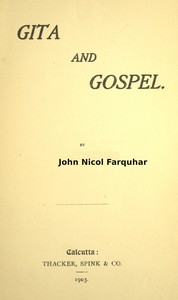
Gita and gospel
free to read
length
27,727 words
a few pages a day
~8 min
finished in
15 days
full read
1h 56m
At Folio's default of ten pages a day, you finish Gita and gospel in about 15 days — roughly 8 minutes of reading each morning.
The opening
the first pages of Gita and gospel, free
In the whole literature of the world there are few poems worthy of comparison, either in point of general interest, or of practical influence, with the Bhagavadgītā. It is a philosophical work, yet fresh and readable as poetry; a book of devotion, yet drawing its main inspiration from speculative systems; a dramatic scene from the most fateful battle of early Indian story, yet breathing the leisure and the subtleties of the schools; founded on a metaphysical theory originally atheistic,[1] yet teaching the most reverent adoration of the Lord of all: where shall we find a more fascinating study? Then its influence on educated India has been and still is without a rival. Everybody praises the Upanishads, but very few read them; here and there one finds a student who turns the pages of a Sūtra or looks into Sankara or Rāmānuja, but the most are content to believe without seeing. The Gītā, on the other hand, is read and loved by every educated man. Nor is there any need to apologize for this partiality: the Divine Song is the loveliest flower in the garden of Sanskrit literature.
For the Western mind also the poem has many attractions. The lofty sublimity to which it so often rises, the practical character of much of its teaching, the enthusiastic devotion to the one Lord which breathes through it, and the numerous resemblances it shows to the words of Christ, fill it with unusual interest for men of the West. But while it has many points of affinity with the thought and the religion of Europe, it is nevertheless a genuine product of the soil;[2] indeed it is all the more fit to represent the genius of India that its thought and its poetry are lofty enough to draw the eyes of the West.
What, then, is the Gītā? Can we find our way to the fountain whence the clear stream flows?
A. When the dwelling-place of the ancient Aryan tribes was partly on the outer, partly on the inner, side of the Indus (primeval patronymic of both India and her religion), and the tribesmen were equally at home on the farm and on the battlefield, then it was that the mass of the lyrics that form the Rigveda were made. We need not stay to set forth the various ways in which this unique body of poetry is of value to modern thought. For us it is of interest because it gives us the earliest glimpse of the religion of the Indo-Aryans. That religion is polytheistic and naturalistic. The Vedic hymns laud the powers of nature and natural phenomena as personal gods. They praise also, as distinct powers, the departed fathers. Such is undoubtedly the general character of the religion of that age. On the other hand, the hymns to Varuna bring us very near monotheism indeed.[3]
It is, however, only at a later period when the Aryan conquest had moved out of the Punjab to the South and West, and just on the eve of the formation of the Rigveda as a collection of religious hymns, that we find the beginnings of philosophic speculation.[4] A few hymns, chiefly in the tenth Mondol, ask questions about the origin of the universe, and venture some naive guesses on that tremendous subject. Some of the hymns[5] take for granted the existence of primeval matter, and ask how or by whom it was transformed into a cosmos. In others[6] there is more monotheistic feeling, and a Creator, either Hiranyagarbha or Visvakarman, is described. In others[7] the strain of thought is agnostic.
B. With the collection of the hymns of the Rigveda we pass into a new and very different period, the literature of which is altogether priestly. To this age belong the two great sacerdotal manuals, the Sāmaveda[8] or Chant-book, and the Yajurveda[9] or Sacrifice-book, and those extraordinary collections of priestly learning, mythology and mysticism, the Brāhmanas.[10] These books introduce us to changed times and changed men, to new places and a new range of ideas. The fresh poetry of the youth of India has given place to the most prosaic and uninteresting disquisitions in the whole world.[11] The home of this literature is the great holy land of Brahman culture, stretching from the Sutlej on the West to the junction of the Jumna and the Ganges at Prayāga.[12] In this period the doctrine of the transmigration of the soul first appears.[13]
Keep going from exactly here — Folio remembers your place and serves the next portion tomorrow.
continue reading Gita and gospelAbout this free edition
Gita and gospel by J. N. Farquhar (1861-1929) is free to read in full. Folio serves it in daily portions you can actually finish, tracks your streak and reading position across devices, and reads every page aloud with a built-in narrator. The text comes from Project Gutenberg.
More like Gita and gospel
Meditations
Folio
Meditations
Marcus Aurelius
The Enchiridion
Epictetus

Thus Spake Zarathustra
Friedrich Nietzsche
Beyond Good and Evil
Folio
Beyond Good and Evil
Friedrich Nietzsche
The Genealogy of Morals
Folio
The Genealogy of Morals
Friedrich Nietzsche
The Republic
Folio
The Republic
Plato
Apology
Folio
Apology
Plato
Crito
Folio
Crito
Plato