length
39,804 words
a few pages a day
~8 min
finished in
21 days
full read
2h 46m
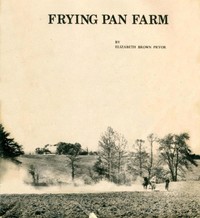
At Folio's default of ten pages a day, you finish Frying Pan Farm in about 21 days — roughly 8 minutes of reading each morning.
The opening
the first pages of Frying Pan Farm, free
Cooperation and goodwill were the essential characteristics of the agricultural communities examined in this study, and it has been my pleasure to discover that those qualities are still very evident today among the county's rural folk. Many residents of the Herndon area shared their personal memories and offered really old-fashioned Virginia hospitality to those doing research. Without the help of Neal Bailey, Elizabeth Ellmore, Emma Ellmore, Virginia Greear, Holden Harrison, Mr. and Mrs. Ray Harrison, Margaret Mary Lee, Edna Middleton, John Middleton, Rebecca Middleton, Richard Peck, Elizabeth Rice, Louise Ryder, and Mary Scott, this monograph could not have been completed.
Special mention must be made of retired County Agricultural Extension Agent Joseph Beard, who shared his detailed knowledge of county agricultural practices on numerous occasions. He willingly arranged interviews with county farmers, and often helped to break the ice by accompanying the interviewer. This was always done with abundant good humor and his enthusiasm was infectious. I am also particularly grateful to Dr. John T. Schlebecker of the Extractive Industries Division of the Smithsonian Institution. His expertise in the field of agricultural technology and special interest in living historical farms added significantly to the quality of the monograph. Additional thanks go to Anthony Pryor of the Rockefeller Foundation who read this paper and helped to put its conclusions in perspective with trends of agricultural economics.
Nan Netherton originally conceived the project and did much of the initial groundwork. The majority of interviews with Floris area farmers were conducted by her. Mrs. Netherton's reputation in the county made it possible for us both to acquire private papers and photographs which might otherwise have been overlooked or withheld. What is more, she sympathetically "initiated" me into the project, offering suggestions and constructive aid without discouraging my own ideas about the direction the study should take.
Elizabeth Brown Pryor Fairfax, Virginia June 21, 1979
INTRODUCTION
In 1925 Fairfax County was still predominantly rural in character. Farmers occupied over half of the county's land, living on individual holdings which averaged 62.5 acres. Nearly 85% of these farmers were white and of this group only 15% did not own their own farm. They shared their domain with 3,605 horses, 11,636 head of cattle, 5,408 swine, 171,526 chickens and 178 mules. One-tenth of the farms enjoyed the use of a tractor and 25% had a radio. The average capital holding on land and buildings was $8,229, and the Fairfax County farmer netted something less than $1,000 income annually.[1]
These figures give a skeleton picture of Fairfax County's most prominent citizen in the period between the two World Wars; when the statistics are translated in prose, his shadowy form gains weight. The farmer at this time was a small landowner, possessing a farm only as large as his own family and a few hired laborers could manage. Although his capital holdings were not huge, they were well above the state average. He had the prestige of being a homeowner, and the pride of working his own soil, perhaps the same soil his grandparents had tilled. The rural family raised livestock for their own use, but principally for the market, and favored draft horses over tractors, mules or oxen to power farm equipment. This farmer's time was spent on a myriad of duties and details--his function was not yet totally specialized--ranging from butchering hogs to building chicken coops to thinning corn. He worked for himself, planning the day's activities, relying on his own judgment and initiative to cope with the varying responsibilities he shouldered. His numerical prominence gave him political and social leverage. It was the rural way of life that shaped the county and his demands which needed to be met.
Keep going from exactly here — Folio remembers your place and serves the next portion tomorrow.
continue reading Frying Pan FarmAbout this free edition
Frying Pan Farm by Elizabeth Brown Pryor is free to read in full. Folio serves it in daily portions you can actually finish, tracks your streak and reading position across devices, and reads every page aloud with a built-in narrator. The text comes from Project Gutenberg.
More like Frying Pan Farm
The History of the Peloponnesian War
Folio
The History of the Peloponnesian War
Thucydides
The History of Herodotus
Folio
The History of Herodotus
Herodotus
The Gallic Wars
Folio
The Gallic Wars
Julius Caesar
Anabasis
Folio
Anabasis
Xenophon
The Lives of the Twelve Caesars
Folio
The Lives of the Twelve Caesars
Suetonius
Germania
Folio
Germania
Tacitus
The History of the Decline and Fall of the Roman Empire
Edward Gibbon
The Travels of Marco Polo
Marco Polo