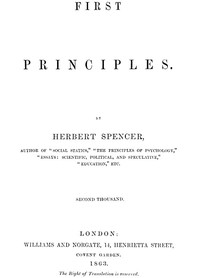
length
166,713 words
a few pages a day
~8 min
finished in
88 days
full read
11h 35m
At Folio's default of ten pages a day, you finish First Principles in about 88 days — roughly 8 minutes of reading each morning.
The opening
the first pages of First Principles, free
This volume is the first of a series described in a prospectus originally distributed in March, 1860. Of that prospectus, the annexed is a reprint.
A SYSTEM OF PHILOSOPHY.
Mr. Herbert Spencer proposes to issue in periodical parts a connected series of works which he has for several years been preparing. Some conception of the general aim and scope of this series may be gathered from the following Programme.
FIRST PRINCIPLES.
PART I. THE UNKNOWABLE.—Carrying a step further the doctrine put into shape by Hamilton and Mansel; pointing out the various directions in which Science leads to the same conclusions; and showing that in this united belief in an Absolute that transcends not only human knowledge but human conception, lies the only possible reconciliation of Science and Religion.
PART II. LAWS OF THE KNOWABLE.—A statement of the ultimate principles discernible throughout all manifestations of the Absolute—those highest generalizations now being disclosed by Science which are severally true not of one class of phenomena but of all classes of phenomena; and which are thus the keys to all classes of phenomena.[1]
[_In logical order should here come the application of these First Principles to Inorganic Nature. But this great division it is proposed to pass over: partly because, even without it, the scheme is too extensive; and partly because the interpretation of Organic Nature after the proposed method, is of more immediate importance. The second work of the series will therefore be_—]
THE PRINCIPLES OF BIOLOGY.
VOL. I.
PART I. THE DATA OF BIOLOGY.—Including those general truths of Physics and Chemistry with which rational Biology must set out.
II. THE INDUCTIONS OF BIOLOGY.—A statement of the leading generalizations which Naturalists, Physiologists, and Comparative Anatomists, have established.
III. THE EVOLUTION OF LIFE.—Concerning the speculation commonly known as “The Development Hypothesis”—its à priori and à posteriori evidences.
VOL. II.
IV. MORPHOLOGICAL DEVELOPMENT.—Pointing out the relations that are everywhere traceable between organic forms and the average of the various forces to which they are subject; and seeking in the cumulative effects of such forces a theory of the forms.
V. PHYSIOLOGICAL DEVELOPMENT.—The progressive differentiation of functions similarly traced; and similarly interpreted as consequent upon the exposure of different parts of organisms to different sets of conditions.
VI. THE LAWS OF MULTIPLICATION.—Generalizations respecting the rates of reproduction of the various classes of plants and animals; followed by an attempt to show the dependence of these variations upon certain necessary causes.[2]
THE PRINCIPLES OF PSYCHOLOGY.
VOL. I.
PART I. THE DATA OF PSYCHOLOGY.—Treating of the general connexions of Mind and Life and their relations to other modes of the Unknowable.
II. THE INDUCTIONS OF PSYCHOLOGY.—A digest of such generalizations respecting mental phenomena as have already been empirically established.
III. GENERAL SYNTHESIS.—A republication, with additional chapters, of the same part in the already-published The Principles of Psychology.
IV. SPECIAL SYNTHESIS.—A republication, with extensive revisions and additions, of the same part, &c. &c.
Keep going from exactly here — Folio remembers your place and serves the next portion tomorrow.
continue reading First PrinciplesAbout this free edition
First Principles by Herbert Spencer (1820-1903) is free to read in full. Folio serves it in daily portions you can actually finish, tracks your streak and reading position across devices, and reads every page aloud with a built-in narrator. The text comes from Project Gutenberg.
More like First Principles
The Philosophy of Style
Folio
The Philosophy of Style
Herbert Spencer
Essays: Scientific, Political, and Speculative
Folio
Essays: Scientific, Political, and Speculative
Herbert Spencer
The Data of Ethics
Herbert Spencer
The Right to Ignore the State
Folio
The Right to Ignore the State
Herbert Spencer
Meditations
Folio
Meditations
Marcus Aurelius

The Enchiridion
Epictetus

Thus Spake Zarathustra
Friedrich Nietzsche
Beyond Good and Evil
Folio
Beyond Good and Evil
Friedrich Nietzsche