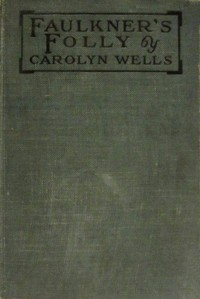
Faulkner's Folly
free to read
length
58,383 words
a few pages a day
~8 min
finished in
31 days
full read
4h 3m
At Folio's default of ten pages a day, you finish Faulkner's Folly in about 31 days — roughly 8 minutes of reading each morning.
The opening
the first pages of Faulkner's Folly, free
Beatrice Faulkner paused a moment, on her way down the great staircase, to gaze curiously at the footman in the lower hall.
A perfectly designed and nobly proportioned staircase is perhaps the finest indoor background for a beautiful woman, but though Mrs. Faulkner had often taken advantage of this knowledge, there was no such thought in her mind just now. She descended the few remaining steps, her eyes still fixed on the astonishing sight of a footman's back, when he should have been standing at attention. He might not have heard her soft footfall, but he surely had no business to be peering in at a door very slightly ajar.
Faulkner's Folly was the realised dream of the architect who had been its original owner. It was a perfect example of the type known in England as Georgian and in our own country as Colonial, a style inspired by the Italian disciples of Palladio, and as developed by Inigo Jones and Christopher Wren, it had seemed to James Faulkner to possess the joint qualities of comfort and dignity that made it ideal for a home. The house was enormous, the rooms perfectly proportioned, and the staircase had been the architect's joy and delight. It showed the wooden wainscoting, which was handed down from the Jacobeans; broad, deep steps with low risers, large, square landings, newels with mitred tops and rather plain balusters. But the carved wood necessary to carry out the plans, the great problems of lighting, the necessity for columned galleries and long, arched and recessed windows, together with the stupendous outlay for appropriate grounds and gardens, overtaxed the available funds and Faulkner's Folly, in little more than two years after its completion, was sold for less than its intrinsic value.
James Faulkner died, some said of a broken heart, but his wife had weathered the blow, and was, at the present time, a guest in what had been her own home.
The man who bought Faulkner's Folly was one who could well appreciate all its exquisite beauty and careful workmanship. Eric Stannard, the artist and portrait painter, of international reputation and great wealth, and a friend of long standing, took Faulkner's house with much joy in the acquisition and sympathy for the man who must give it up.
A part of the purchase price was to be a portrait of Mrs. Faulkner by the master hand of the new owner; but Faulkner's death had postponed this, and now, a widow of two years, Beatrice was staying at the Stannards' while the picture was being painted. Partly because of sentiment toward her husband's favourite feature of the house, and partly because of her own recognition of its artistic possibilities, Beatrice had chosen the stairs as her background, and rarely did she descend them without falling into pose for a moment at the spot she had selected for the portrait.
But on this particular evening, Beatrice had no thought of her picture, as she noticed the strange sight of the usually expressionless and imperturbable footman, with his face pressed against the slight opening of the studio door.
"Blake," she said, sharply, and then stopped, regretting her speech. As the Stannards' guest, she had no right or wish to reprove her hosts' servants, but it was well-nigh impossible for her to forget the days of her own rule in that house.
Even as she looked, the man turned toward her a white and startled face,--it seemed almost as if he welcomed her appearance.
"Blake! What is it?" she said, alarmed at his manner. "What are you doing?"
"I--heard a strange sound, Madame,--from the studio----"
"A strange sound?" and Beatrice came along the hall toward the footman.
"And the lights in there, just went out----"
"The lights went out! What do you mean, Blake? It is not your business if lights in rooms are turned off or on, is it?"
"No, Madame--but--there, Madame! Did you not hear that?"
Keep going from exactly here — Folio remembers your place and serves the next portion tomorrow.
continue reading Faulkner's FollyAbout this free edition
Faulkner's Folly by Carolyn Wells (1862-1942) is free to read in full. Folio serves it in daily portions you can actually finish, tracks your streak and reading position across devices, and reads every page aloud with a built-in narrator. The text comes from Project Gutenberg.
More like Faulkner's Folly
The Gold Bag
Folio
The Gold Bag
Carolyn Wells
Vicky Van
Folio
Vicky Van
Carolyn Wells

The Deep Lake Mystery
Carolyn Wells
The Mystery of the Sycamore
Carolyn Wells

The Mystery Girl
Carolyn Wells
The Room with the Tassels
Carolyn Wells
The Diamond Pin
Folio
The Diamond Pin
Carolyn Wells
In the Onyx Lobby
Carolyn Wells