Émile; Or, Concerning Education; Extracts
Folio
length
50,586 words
a few pages a day
~8 min
finished in
27 days
full read
3h 31m
At Folio's default of ten pages a day, you finish Émile; Or, Concerning Education; Extracts in about 27 days — roughly 8 minutes of reading each morning.
The opening
the first pages of Émile; Or, Concerning Education; Extracts, free
M. Jules Steeg has rendered a real service to French and American teachers by his judicious selections from Rousseau's Émile. For the three-volume novel of a hundred years ago, with its long disquisitions and digressions, so dear to the heart of our patient ancestors, is now distasteful to all but lovers of the curious in books.
"Émile" is like an antique mirror of brass; it reflects the features of educational humanity no less faithfully than one of more modern construction. In these few pages will be found the germ of all that is useful in present systems of education, as well as most of the ever-recurring mistakes of well-meaning zealots.
The eighteenth century translations of this wonderful book have for many readers the disadvantage of an English style long disused. It is hoped that this attempt at a new translation may, with all its defects, have the one merit of being in the dialect of the nineteenth century, and may thus reach a wider circle of readers.
INTRODUCTION.
Jean Jacques Rousseau's book on education has had a powerful influence throughout Europe, and even in the New World. It was in its day a kind of gospel. It had its share in bringing about the Revolution which renovated the entire aspect of our country. Many of the reforms so lauded by it have since then been carried into effect, and at this day seem every-day affairs. In the eighteenth century they were unheard-of daring; they were mere dreams.
Long before that time the immortal satirist Rabelais, and, after him, Michael Montaigne, had already divined the truth, had pointed out serious defects in education, and the way to reform. No one followed out their suggestions, or even gave them a hearing. Routine went on its way. Exercises of memory,--the science that consists of mere words,--pedantry, barren and vain-glorious,--held fast their "bad eminence." The child was treated as a machine, or as a man in miniature, no account being taken of his nature or of his real needs; without any greater solicitude about reasonable method--the hygiene of mind--than about the hygiene of the body.
Rousseau, who had educated himself, and very badly at that, was impressed with the dangers of the education of his day. A mother having asked his advice, he took up the pen to write it; and, little by little, his counsels grew into a book, a large work, a pedagogic romance.
This romance, when it appeared in 1762, created a great noise and a great scandal. The Archbishop of Paris, Christophe de Beaumont, saw in it a dangerous, mischievous work, and gave himself the trouble of writing a long encyclical letter in order to point out the book to the reprobation of the faithful. This document of twenty-seven chapters is a formal refutation of the theories advanced in "Émile."
The archbishop declares that the plan of education proposed by the author, "far from being in accordance with Christianity, is not fitted to form citizens, or even men." He accuses Rousseau of irreligion and of bad faith; he denounces him to the temporal power as animated "by a spirit of insubordination and of revolt." He sums up by solemnly condemning the book "as containing an abominable doctrine, calculated to overthrow natural law, and to destroy the foundations of the Christian religion; establishing maxims contrary to Gospel morality; having a tendency to disturb the peace of empires, to stir up subjects to revolt against their sovereign; as containing a great number of propositions respectively false, scandalous, full of hatred toward the Church and its ministers, derogating from the respect due to Holy Scripture and the traditions of the Church, erroneous, impious, blasphemous, and heretical."
In those days, such a condemnation was a serious matter; its consequences to an author might be terrible. Rousseau had barely time to flee. His arrest was decreed by the parliament of Paris, and his book was burned by the executioner. A few years before this, the author would have run the risk of being burned with his book.
Keep going from exactly here — Folio remembers your place and serves the next portion tomorrow.
continue reading Émile; Or, Concerning Education; ExtractsAbout this free edition
Émile; Or, Concerning Education; Extracts by Jean-Jacques Rousseau (1712-1778) is free to read in full. Folio serves it in daily portions you can actually finish, tracks your streak and reading position across devices, and reads every page aloud with a built-in narrator. The text comes from Project Gutenberg.
More like Émile; Or, Concerning Education; Extracts
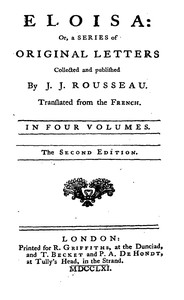
Eloisa
Jean-Jacques Rousseau
The social contract & discourses
Folio
The social contract & discourses
Jean-Jacques Rousseau
Emile
Folio
Emile
Jean-Jacques Rousseau
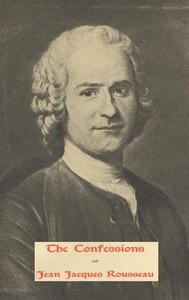
The Confessions of Jean Jacques Rousseau
Jean-Jacques Rousseau
Meditations
Folio
Meditations
Marcus Aurelius
The Enchiridion
Epictetus

Thus Spake Zarathustra
Friedrich Nietzsche
Beyond Good and Evil
Folio
Beyond Good and Evil
Friedrich Nietzsche