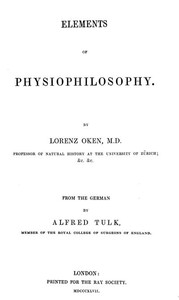
Elements of Physiophilosophy
free to read
length
215,138 words
a few pages a day
~8 min
finished in
114 days
full read
14h 56m
At Folio's default of ten pages a day, you finish Elements of Physiophilosophy in about 114 days — roughly 8 minutes of reading each morning.
The opening
the first pages of Elements of Physiophilosophy, free
Variations in hyphenation have been standardised, but other variations in spelling, accents and punctuation are as in the original.
There are several very wide tables in the book (e.g. Table A is 16 columns/380 characters wide). These have been divided into blocks of 3 or 4 columns. The row alignment has been preserved and, where appropriate. the 1st column repeated for each block.
The Errata and Corrigenda have been implemented, except for the final item:
For the words evolution and evolved, read passim in the Botanical and Zoological parts, perfection and perfected, as the text may require.
Italics are represented thus italic.
* * * * *
THE
RAY SOCIETY.
INSTITUTED MDCCCXLIV.
[Illustration: Portrait of a man, signed W Bagg]
LONDON.
MDCCCXLVII.
ELEMENTS
OF
PHYSIOPHILOSOPHY.
BY
LORENZ OKEN, M.D.
PROFESSOR OF NATURAL HISTORY AT THE UNIVERSITY OF ZÜRICH; &c. &c.
FROM THE GERMAN
BY
ALFRED TULK,
MEMBER OF THE ROYAL COLLEGE OF SURGEONS OF ENGLAND.
LONDON: PRINTED FOR THE RAY SOCIETY. MDCCCXLVII.
C. AND J. ADLARD, PRINTERS, BARTHOLOMEW CLOSE.
"Of all truths relating to phenomena, the most valuable to us are those which relate to the order of their succession. On a knowledge of these is founded every reasonable anticipation of future facts, and whatever power we possess of influencing those facts to our advantage. Even the laws of geometry are chiefly of practical importance to us as being a portion of the premises from which the order of the succession of phenomena may be inferred."
JOHN STUART MILL.
Begun in the autumn of the year 1845, without the cognizance, or at the suggestion of a single human being, the present Translation is due to the fact of its original having encountered a somewhat kindred spirit, and aroused therein the desire to render others participant, if possible, in the large amount of instruction it is so well calculated to afford. And now that the work is done, what remains for the labourer at second-hand to say by way of preamble to his newly-dressed wares? Had the book been printed within the pale of a philosophical or physico-theological sect, the Translator's final duty would have been clearly enough prescribed. Already bound to the profession of "particular tenets," his main object would be to indulge in a laudatory but servile abstract of his author's doctrines, or, if having set out with the expressed intention of illustrating their bearings upon the state of science past, present, and to come, he would become so drunk beforehand with the large and unbridled potation of his creed, as to surprise the casual reader by informing him that such an intention is useless, for the two stand in direct antithesis to each other. Examples of this mode of procedure are not wanting at the present day, whether at home or abroad. They are the produce of that spirit, which, rife enough in the Middle Ages, has been so graphically described by Professor Whewell under the title of the "Commentatorial," and "whose professed object is to explain, to enforce, to illustrate doctrines assumed to be true, but not to obtain additional truths or new generalizations." While from dealings of this character, as being utterly opposed to the sacred cause of Truth, I turn away with feelings of repugnance, to which the lessons of some personal experience have lent their aid, it is not my business, upon the other hand, to enter the lists of controversy against those who, having neither the capacity, nor the desire of its cultivation, for the higher walks of science, delight to dismiss a work of the present kind with some idle anathema of mysticism or evasive outcry for more facts.
Keep going from exactly here — Folio remembers your place and serves the next portion tomorrow.
continue reading Elements of PhysiophilosophyAbout this free edition
Elements of Physiophilosophy by Lorenz Oken (1779-1851) is free to read in full. Folio serves it in daily portions you can actually finish, tracks your streak and reading position across devices, and reads every page aloud with a built-in narrator. The text comes from Project Gutenberg.
More like Elements of Physiophilosophy
Meditations
Folio
Meditations
Marcus Aurelius
The Enchiridion
Epictetus
Thus Spake Zarathustra
Friedrich Nietzsche
Beyond Good and Evil
Folio
Beyond Good and Evil
Friedrich Nietzsche
The Genealogy of Morals
Folio
The Genealogy of Morals
Friedrich Nietzsche
The Republic
Folio
The Republic
Plato
Apology
Folio
Apology
Plato
Crito
Folio
Crito
Plato