length
36,712 words
a few pages a day
~8 min
finished in
20 days
full read
2h 33m
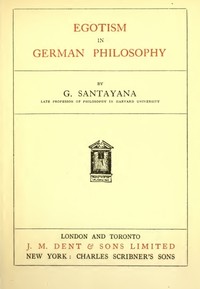
At Folio's default of ten pages a day, you finish Egotism in German Philosophy in about 20 days — roughly 8 minutes of reading each morning.
The opening
the first pages of Egotism in German Philosophy, free
This book is one of the many that the present war has brought forth, but it is the fruit of a long gestation. During more than twenty years, while I taught philosophy at Harvard College, I had continual occasion to read and discuss German metaphysics. From the beginning it wore in my eyes a rather questionable shape. Under its obscure and fluctuating tenets I felt something sinister at work, something at once hollow and aggressive. It seemed a forced method of speculation, producing more confusion than it found, and calculated chiefly to enable practical materialists to call themselves idealists and rationalists to remain theologians. At the same time the fear that its secret might be eluding me, seeing that by blood and tradition I was perhaps handicapped in the matter, spurred me to great and prolonged efforts to understand what confronted me so bewilderingly. I wished to be as clear and just about it as I could--more clear and just, indeed, than it ever was about itself.
For the rest, German philosophy was never my chief interest, and I write frankly as an outsider, with no professorial pretensions; merely using my common [Pg 6] reason in the presence of claims put forth by others to a logical authority and a spiritual supremacy which they are far from possessing.
A reader indoctrinated in the German schools is, therefore, free not to read further. My object is neither to repeat his familiar arguments in their usual form, nor to refute them; my object is to describe them intelligibly and to judge them from the point of view of the layman, and in his interests. For those who wish to study German philosophy, the original authors are at hand: all I would give here is the aroma of German philosophy that has reached my nostrils. If the reader has smelt something of the kind, so much the better: we shall then understand each other. The function of history or of criticism is not passively to reproduce its subject-matter. One real world, with one stout corpus of German philosophy, is enough. Reflection and description are things superadded, things which ought to be more winged and more selective than what they play upon. They are echoes of reality in the sphere of art, sketches which may achieve all the truth appropriate to them without belying their creative limitations: for their essence is to be intellectual symbols, at once indicative and original.
Egotism--subjectivity in thought and wilfulness in morals--which is the soul of German philosophy, [Pg 7] is by no means a gratuitous thing. It is a genuine expression of the pathetic situation in which any animal finds itself upon earth, and any intelligence in the universe. It is an inevitable and initial circumstance in life. But like every material accident, it is a thing to abstract from and to discount as far as possible. The perversity of the Germans, the childishness and sophistry of their position, lies only in glorifying what is an inevitable impediment, and in marking time on an earthly station from which the spirit of man--at least in spirit--is called to fly.
Keep going from exactly here — Folio remembers your place and serves the next portion tomorrow.
continue reading Egotism in German PhilosophyAbout this free edition
Egotism in German Philosophy by George Santayana (1863-1952) is free to read in full. Folio serves it in daily portions you can actually finish, tracks your streak and reading position across devices, and reads every page aloud with a built-in narrator. The text comes from Project Gutenberg.
More like Egotism in German Philosophy
The Sense of Beauty
Folio
The Sense of Beauty
George Santayana
Soliloquies in England, and Later Soliloquies
Folio
Soliloquies in England, and Later Soliloquies
George Santayana
Interpretations of Poetry and Religion
Folio
Interpretations of Poetry and Religion
George Santayana
The Life of Reason: The Phases of Human Progress
George Santayana
Meditations
Folio
Meditations
Marcus Aurelius

The Enchiridion
Epictetus

Thus Spake Zarathustra
Friedrich Nietzsche
Beyond Good and Evil
Folio
Beyond Good and Evil
Friedrich Nietzsche