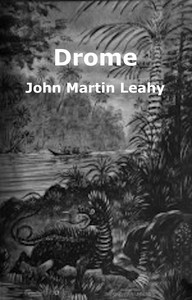
length
68,562 words
a few pages a day
~8 min
finished in
37 days
full read
4h 46m
At Folio's default of ten pages a day, you finish Drome in about 37 days — roughly 8 minutes of reading each morning.
The opening
the first pages of Drome, free
"But please to remember that although we can prove to our own satisfaction that some things really exist, we can not prove that any imaginable thing outside our experience can not possibly exist. Imagine the wildest impossibility you can think of; you will not induce a modern man of science to admit the impossibility of it as an absolute."--F. Marion Crawford: Whosoever Shall Offend.
On my return from the Antarctic, it was with surprise and grief that I learned of the very strange and wholly inexplicable disappearance of Milton Rhodes and William Carter. The special work of Rhodes was in a department of science very different from that to which my own pertains; but we were much interested in each other's investigations and problems, and, indeed, we even conducted some experiments together.
It will be quite patent, then, that, as the Multnomah made her way northward, I was looking forward with much pleasure anticipated to the meeting with my friend--with all that I had to tell him of our adventures and discoveries in the region of the Southern Pole, picturing to myself the astonishment that would most certainly be his on seeing some of the things brought from that mysterious region; above all, imagining his reaction when we would behold our poor Sleeping Beauty in her crystal coffin, in which she had lain (neither living nor dead, as I believe; or as my friend Bond McQuestion has it, in a living death) from some awful day in that period men call the Pliocene.
And then to come back and find that Milton Rhodes had disappeared, and with him William Carter!
They had vanished as suddenly and mysteriously as though a secret departure had been made for the moon or Mars or Venus.
It was very little, I was surprised to learn, that any one could tell me. And that very little presented some very singular features indeed. This was certain: Milton Rhodes had planned to begin in a very few days a series of experiments (the exact nature of which was unknown) that would claim his close and undivided attention for weeks, possibly months, experiments that would keep him imprisoned, so to speak, in his laboratory. But he had not even begun those experiments; he had vanished. What had caused the sudden change? What had happened?
As for William Carter, he was about to start on a journey which would take him as far as Central America. Again, what had happened? What had caused him to give over all that he had purposed and go and disappear along with Milton Rhodes?
Here there was but one bit of light, but that light seemed to make the problem the more perplexing. The very day before that on which Rhodes and Carter got into the automobile and started for Mount Rainier, some visitor had come and had been received by Rhodes in the library, Carter being present at this meeting. Some of the concomitants of this visit had been a little unusual, it was remembered, though at the time no one had given that a thought.
It was believed that this man had remained there with Rhodes and Carter for a period somewhat extended. But who had this mysterious visitor been? It was, of course, held as certain that something told by this man to the scientist and his companion was the key to the mystery. But what had the visitor told them?
We knew that Rhodes and Carter had gone to Mount Rainier. But why had they so suddenly abandoned all their plans and gone to the mountain? On the mountain they had disappeared. More than that no man could tell.
And now we come to another enigma. Rhodes seldom drove a car himself. On this trip, however, he was at the wheel. The only other occupant of that car was Carter. And Rhodes had left with his chauffeur, Everett Castleman, instructions over which I puzzled my head a good deal but without my ever becoming any the wiser. These instructions were somewhat extraordinary.
Keep going from exactly here — Folio remembers your place and serves the next portion tomorrow.
continue reading DromeAbout this free edition
Drome by John Martin Leahy (1886-1967) is free to read in full. Folio serves it in daily portions you can actually finish, tracks your streak and reading position across devices, and reads every page aloud with a built-in narrator. The text comes from Project Gutenberg.
More like Drome
The Time Machine
H. G. Wells

The War of the Worlds
H. G. Wells
The Invisible Man
H. G. Wells

The Island of Doctor Moreau
H. G. Wells
The First Men in the Moon
H. G. Wells
The Sleeper Awakes
Folio
The Sleeper Awakes
H. G. Wells
The Food of the Gods and How It Came to Earth
Folio
The Food of the Gods and How It Came to Earth
H. G. Wells

Frankenstein
Mary Shelley