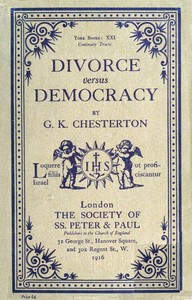
length
3,940 words
a few pages a day
~8 min
finished in
3 days
full read
16 min
At Folio's default of ten pages a day, you finish Divorce versus Democracy in about 3 days — roughly 8 minutes of reading each morning.
The opening
the first pages of Divorce versus Democracy, free
I have been asked to put forward in pamphlet form this rather hasty essay as it appeared in “Nash’s Magazine”; and I do so by the kind permission of the editor. The rather chaotic quality of its journalism it is now impossible to alter. The convictions upon which it is based are unaltered and unalterable. Indeed, in so far as circumstances have since affected them, they are greatly strengthened. In so far as there was something sporadic and seemingly irrelevant in the writing, it was partly because I was contending against an evil that was diffused and indefinable, at once tentative and ubiquitous. Since then that disease has come to a head and burst; primarily in the North of Europe. By that historic habit which generally makes one European people the standard-bearer of a social tendency, which made the Empire a Roman Empire and the Revolution a French Revolution, the North Germans have become the peculiar champions of that modern change which would make the State infinitely superior to the Family. It is even asserted that Prussian political authority is now encouraging the abandonment of common morality for the support of population; and even if this horrible thing be untrue, it is highly significant that it can be plausibly said of Prussia, and certainly of no other Christian State. And in the new light of action it is possible to trace more clearly the trend towards divorce, as also that trend towards the other pagan institution of slavery, which would certainly have accompanied it. But the enslaving force in Europe struck too early; and the whole movement has been brought to a standstill.
The same circumstances have given an importance to a formula of my own which I still think rather important. It may be summarised as the patriotism of the household. In the experience of nationality we do not admit that any excess of despair can come into the same logical world as desertion. No amount of tragedy need amount to treason. The Christian view of marriage conceives of the home as self-governing in a manner analogous to an independent state; that is, that it may include internal reform and even internal rebellion; but because of the bond, not against it. In this way it is itself a sort of standing reformer of the State; for the State is judged by whether its arrangements bear helpfully or bear hardly on the human fulness and fertility of the free family. Thus the Wicked Ten in Rome were condemned and cast down because their public powers permitted a wrong against the purity of a private family. Thus the mediæval revolt against the Poll Tax began by the authority of an official insulting the authority of a father. Men do not now, any more than then, become sinless by receiving a post in a bureaucracy; and if the domestic affairs of the poor were once put into the hands of mere lawyers and inspectors, the poor would soon find themselves in positions from which there is no exit save by the sword of Virginius and the hammer of Wat Tyler. As for the section of the rich who are still seeking a servile solution, they, of course, are still seeking the extension of divorce. It is only “divide et impera”; and they want the division of sex for the division of labour. The very same economic calculation which makes them encourage tyranny in the shop makes them encourage licence in the family. But now the free families of five great nations have risen against them; and their plot has failed.
G. K. CHESTERTON
Divorce versus Democracy
On this question of divorce I do not profess to be impartial, for I have never perceived any intelligent meaning in the word. I merely (and most modestly) profess to be right. I also profess to be representative: that is, democratic. Now, one may believe in democracy or disbelieve in it. It would be grossly unfair to conceal the fact that there are difficulties on both sides. The difficulty of believing in democracy is that it is so hard to believe--like God and most other good things. The difficulty of disbelieving in democracy is that there is nothing else to believe in. I mean there is nothing else on earth or in earthly politics. Unless an aristocracy is selected by gods, it must be selected by men. It may be negatively and passively permitted, but either heaven or humanity must permit it; otherwise it has no more moral authority than a lucky pickpocket. It is baby talk to talk about “Supermen” or “Nature’s Aristocracy” or “The Wise Few.” “The Wise Few” must be either those whom others think wise--who are often fools; or those who think themselves wise--who are always fools.
Keep going from exactly here — Folio remembers your place and serves the next portion tomorrow.
continue reading Divorce versus DemocracyAbout this free edition
Divorce versus Democracy by G. K. Chesterton (1874-1936) is free to read in full. Folio serves it in daily portions you can actually finish, tracks your streak and reading position across devices, and reads every page aloud with a built-in narrator. The text comes from Project Gutenberg.
More like Divorce versus Democracy
The Innocence of Father Brown
G. K. Chesterton
The Man Who Was Thursday
G. K. Chesterton
The Wisdom of Father Brown
Folio
The Wisdom of Father Brown
G. K. Chesterton
The Club of Queer Trades
Folio
The Club of Queer Trades
G. K. Chesterton
The Man Who Knew Too Much
Folio
The Man Who Knew Too Much
G. K. Chesterton
Manalive
G. K. Chesterton
The Trees of Pride
Folio
The Trees of Pride
G. K. Chesterton
The secret of Father Brown
G. K. Chesterton