length
11,689 words
a few pages a day
~8 min
finished in
7 days
full read
49 min
At Folio's default of ten pages a day, you finish Daedalus in about 7 days — roughly 8 minutes of reading each morning.
The opening
the first pages of Daedalus, free
I have slightly expanded certain parts of this paper since reading it. It has therefore probably lost any unity which it may once have possessed. It will be criticized for its undue and unpleasant emphasis on certain topics. This is necessary if people are to be induced to think about them, and it is the whole business of a university teacher to induce people to think.
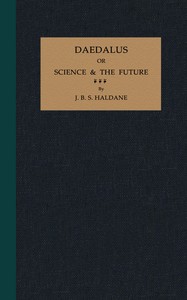
DAEDALUS
OR
SCIENCE AND THE FUTURE
As I sit down to write these pages I can see before me two scenes from my experience of the late war. The first is a glimpse of a forgotten battle of 1915. It has a curious suggestion of a rather bad cinema film. Through a blur of dust and fumes there appear, quite suddenly, great black and yellow masses of smoke which seem to be tearing up the surface of the earth and disintegrating the works of man with an almost visible hatred. These form the chief parts of the picture, but somewhere in the middle distance one can see a few irrelevant looking human figures, and soon there are fewer. It is hard to believe that these are the protagonists in the battle. One would rather choose those huge substantive oily black masses which are so much more conspicuous, and suppose that the men are in reality their servants, and playing an inglorious, subordinate, and fatal part in the combat. It is possible, after all, that this view is correct.
Had I been privileged to watch a battle three years later, the general aspect would have been very similar, but there would have been fewer men and more shell-bursts. There would probably, however, have been one very significant addition. The men would have been running, with mad terror in their eyes, from gigantic steel slugs, which were deliberately, relentlessly, and successfully pursuing them.
The other picture is of three Europeans in India looking at a great new star in the milky way. These were apparently all of the guests at a large dance who were interested in such matters. Amongst those who were at all competent to form views as to the origin of this cosmoclastic explosion, the most popular theory attributed it to a collision between two stars, or a star and a nebula. There seem, however, to be at least two possible alternatives to this hypothesis. Perhaps it was the last judgment of some inhabited world, perhaps a too successful experiment in induced radio-activity on the part of some of the dwellers there. And perhaps also these two hypotheses are identical, and what we were watching that evening was the detonation of a world on which too many men came out to look at the stars when they should have been dancing.
These two scenes suggest, very briefly, a part of the case against science. Has mankind released from the womb of matter a Demogorgon which is already beginning to turn against him, and may at any moment hurl him into the bottomless void? Or is Samuel Butler’s even more horrible vision correct, in which man becomes a mere parasite of machinery, an appendage to the reproductive system of huge and complicated engines which will successively usurp his activities, and end by ousting him from the mastery of this planet? Is the machine-minder engaged on repetition-work the goal and ideal to which humanity is tending? Perhaps a survey of the present trend of science may throw some light on these questions.
But first we may consider for a moment, the question of whether there is any hope of stopping the progress of scientific research. It is after all a very recent form of human activity, and a sufficiently universal protest of mankind would be able to arrest it even now. In the middle ages public opinion made it so dangerous as to be practically impossible, and I am inclined to suspect that Mr. Chesterton, for example, would not be averse to a repetition of this state of things. The late M. Joseph Reinach, an able and not wholly illiberal thinker, publicly advocated it.
Keep going from exactly here — Folio remembers your place and serves the next portion tomorrow.
continue reading DaedalusAbout this free edition
Daedalus by J. B. S. Haldane (1892-1964) is free to read in full. Folio serves it in daily portions you can actually finish, tracks your streak and reading position across devices, and reads every page aloud with a built-in narrator. The text comes from Project Gutenberg.
More like Daedalus
Meditations
Folio
Meditations
Marcus Aurelius

The Enchiridion
Epictetus

Thus Spake Zarathustra
Friedrich Nietzsche
Beyond Good and Evil
Folio
Beyond Good and Evil
Friedrich Nietzsche
The Genealogy of Morals
Folio
The Genealogy of Morals
Friedrich Nietzsche
The Republic
Folio
The Republic
Plato
Apology
Folio
Apology
Plato
Crito
Folio
Crito
Plato