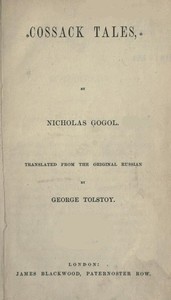
length
72,562 words
a few pages a day
~8 min
finished in
39 days
full read
5h 2m
At Folio's default of ten pages a day, you finish Cossack Tales in about 39 days — roughly 8 minutes of reading each morning.
The opening
the first pages of Cossack Tales, free
A historical sketch placed before a work of fiction must seem, to many, a very inconsistent thing, and yet the title of the present volume, "COSSACK TALES," obliges the translator to give a short account of this sometime warlike race. Such an account is the more wanted, as not only in England, but in all Europe, the notion exists that the Cossacks were something like a Deus ex machinâ, emerging from space at the moment requisite to put a stop to the triumphs if Napoleon I., to drive back to their respective homes the motley array of the twenty nations he brought into Russia, to pitch their tents in the Champs Élysées, to put all things right in Paris, and then to vanish once more into space, where, for more than four centuries, Europe had never so much as perceived their existence.
The invasion of the Tartars in the middle of the thirteenth century took place when Russia was torn asunder by two kindred and yet hostile branches of the house of Rurick: the younger branch had settled in the northern (at the present time the middle) part of the country; the elder, after many struggles and reverses, had succeeded in regaining its inheritance, the ancient metropolis Kieff, and the whole of the southern principalities. Both branches bore a revengeful remembrance of their mutual feuds, and while the elder viewed with jealousy the gradual rise of the northern princes, the latter envied the firm grasp with which the southern princes clutched their long disputed sway. Hence it came that, when hordes of Tartars overran the northern principalities, the princes of the South lent no ear to the entreaties of their northern brethren for help. Hence, also, the reason of these latter remaining inert and submissive to their recent conquerors, the Tartars, when those conquerors laid waste the fertile territories which extended along the south of Russia.
Soon afterwards, the trans-Carpathian parts of Russia, Red Russia, i.e., Galicia, Lodomeria, &c., ceased to be any longer accounted as forming part of Russia. The marshy tracts of land to the east of Poland, White Russia, formed a new and distinct power, Lithuania, soon destined to merge into Poland. The north of Russia, Great Russia, had yet two centuries more to endure the yoke of the Tartars. At this time Southern or Little Russia, called also Ukraine (i.e., the borders), gave birth to a new race, the Cossacks.
The princes of Southern Russia had forsaken their subjects, and gone into Lithuania to seek for a less disturbed dominion than that over a country exposed to the incessant depredations of the Crimean Tartars, and converted into the battle-field of these Tartars with the Russians and the Poles. Their subjects were thus left behind without anybody to look to for protection, or for guidance, in defence of their homes, and revenge for their country being annually wasted by fire and sword by their Crimean neighbours. Reduced to despair at seeing their homes burnt to ashes, their wives and children carried away by those savage invaders, to suffer all the consequences of their rude slavery, these men, to speak in the words of Gogol, "Left orphans, and seeing their country left like a widow after the loss of a mighty husband, held out their hands to one another to be brothers," and this brotherhood gave rise to the Cossacks, whose name for a Russian, even to this day, embodies every idea of the utmost freedom,[1] and who ever since have been ready to fight at the first notice of their country or of their faith being in danger.
At first, they sought a refuge in the wooded islands of the Dnieper, amidst the rapids of this river, and, no doubt, first dwelt under the canopy of heaven amidst the trunks of the trees which they felled for building their huts. This may, perhaps, account for the community assuming the name of Zaporoghian Ssiecha,[2] a name which has become inseparable from the idea of fight and slaughter, of deeds of valour and of cruelty. Having no means of livelihood, they, of course, resolved to procure them at the expense of those by whom they were brought to this desperate situation. They had learnt from their own experience that a good sabre was more to be depended upon than a plough, and that labour and industry were of no avail at such times when everything at any moment might be taken by him who dealt the heavier blow. As all who have seen the worst of miseries, and have nothing to lose in the world, whose life is one of incessant peril, they knew no fear--for them death had lost its horrors. No women were permitted to dwell amongst them; no tears were shed in memory of those who fell in battle or were led away captive; but their exploits were repeatedly sung in the Cossacks' circles, and excited revenge in the hearts of the older, emulation in the hearts of the younger.
Keep going from exactly here — Folio remembers your place and serves the next portion tomorrow.
continue reading Cossack TalesAbout this free edition
Cossack Tales by Nikolai Vasilevich Gogol (1809-1852) is free to read in full. Folio serves it in daily portions you can actually finish, tracks your streak and reading position across devices, and reads every page aloud with a built-in narrator. The text comes from Project Gutenberg.
More like Cossack Tales
Pride and Prejudice
Jane Austen
Sense and Sensibility
Jane Austen
Emma
Folio
Emma
Jane Austen
Persuasion
Folio
Persuasion
Jane Austen
Mansfield Park
Folio
Mansfield Park
Jane Austen
Jane Eyre
Charlotte Brontë
The Tenant of Wildfell Hall
Folio
The Tenant of Wildfell Hall
Anne Brontë
Agnes Grey
Folio
Agnes Grey
Anne Brontë