length
41,318 words
a few pages a day
~8 min
finished in
22 days
full read
2h 52m
At Folio's default of ten pages a day, you finish Comparative Studies in Nursery Rhymes in about 22 days — roughly 8 minutes of reading each morning.
The opening
the first pages of Comparative Studies in Nursery Rhymes, free
_The House that Jack built--and the Malt that lay Within the House--the Rat that ate the Malt-- The Cat, that in that sanguinary way Punished the poor thing for its venial fault-- The Worrier-Dog--the Cow with crumpled horn-- And then--ah yes! and then--the Maiden all forlorn!_
_O Mrs. Gurton--(may I call thee Gammer?) Thou more than mother to my infant mind! I loved thee better than I loved my grammar-- I used to wonder why the Mice were blind, And who was gardener to Mistress Mary, And what--I don't know still--was meant by "quite contrary."_
C. S. C.
The dates that stand after the separate rhymes refer to the list of English collections on p. 11; the capital letters in brackets refer to the list of books on p. 221.
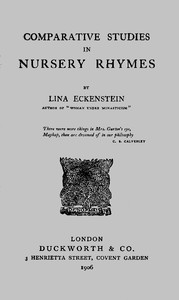
COMPARATIVE STUDIES IN NURSERY RHYMES
CHAPTER I
FIRST APPEARANCE OF RHYMES IN PRINT
The study of folk-lore has given a new interest to much that seemed insignificant and trivial. Among the unheeded possessions of the past that have gained a fresh value are nursery rhymes. A nursery rhyme I take to be a rhyme that was passed on by word of mouth and taught to children before it was set down in writing and put into print. The use of the term in this application goes back to the early part of the nineteenth century. In 1834 John Gawler, afterwards Bellenden Ker, published the first volume of his Essay on the Archaiology of Popular English Phrases and Nursery Rhymes, a fanciful production. Prior to this time nursery rhymes were usually spoken of as nursery songs.
The interest in these "unappreciated trifles of the nursery," as Rimbault called them, was aroused towards the close of the eighteenth century. In a letter which Joseph Ritson wrote to his little nephew, he mentioned the collection of rhymes known as Mother Goose's Melody, and assured him that he also would set about collecting rhymes.[1] His collection of rhymes is said, in the Dictionary of National Biography, to have been published at Stockton in 1783 under the title Gammer Gurton's Garland. A copy of an anonymous collection of rhymes published by Christopher and Jennett at Stockton, which is called Gammer Gurton's Garland or the Nursery Parnassus, is now at the British Museum, and is designated as a "new edition with additions." It bears no name and no date, but its contents, which consist of over seventy rhymes, agree with parts 1 and 2 of a large collection of nursery rhymes, including over one hundred and forty pieces, which were published in 1810 by the publisher R. Triphook, of 37 St. James Street, London, who also issued other collections made by Ritson.
[1] Letters of Joseph Ritson, edited by his Nephew, 1833. 27 April, 1781.
The collection of rhymes known as Mother Goose's Melody, which aroused the interest of Ritson, was probably the toy-book which was entered for copyright in London on 28 December, 1780. Its title was Mother Goose's Melody or Sonnets for the Cradle, and it was entered by John Carnan, the stepson of the famous publisher John Newbery, who had succeeded to the business in partnership with Francis Newbery.[2] Of this book no copy is known to exist. Toy-books, owing to the careless way in which they are handled, are amongst the most perishable literature. Many toy-books are known to have been issued in hundreds of copies, yet of some of these not a single copy can now be traced.
[2] Welsh, Ch., A Publisher of the Last Century, 1885, p. 272.
Keep going from exactly here — Folio remembers your place and serves the next portion tomorrow.
continue reading Comparative Studies in Nursery RhymesAbout this free edition
Comparative Studies in Nursery Rhymes by Lina Eckenstein (1857-1931) is free to read in full. Folio serves it in daily portions you can actually finish, tracks your streak and reading position across devices, and reads every page aloud with a built-in narrator. The text comes from Project Gutenberg.
More like Comparative Studies in Nursery Rhymes
The History of the Peloponnesian War
Folio
The History of the Peloponnesian War
Thucydides
The History of Herodotus
Folio
The History of Herodotus
Herodotus
The Gallic Wars
Folio
The Gallic Wars
Julius Caesar
Anabasis
Folio
Anabasis
Xenophon
The Lives of the Twelve Caesars
Folio
The Lives of the Twelve Caesars
Suetonius
Germania
Folio
Germania
Tacitus

The History of the Decline and Fall of the Roman Empire
Edward Gibbon
The Travels of Marco Polo
Marco Polo