Cicero's Tusculan Disputations
Folio
Cicero's Tusculan Disputations
free to read
length
181,527 words
a few pages a day
~8 min
finished in
96 days
full read
12h 36m
At Folio's default of ten pages a day, you finish Cicero's Tusculan Disputations in about 96 days — roughly 8 minutes of reading each morning.
The opening
the first pages of Cicero's Tusculan Disputations, free
HARPER & BROTHERS will send either of the above works by mail, postage prepaid, to any part of the United States, on receipt of the price.
NOTE.
The greater portion of the Republic was previously translated by Francis Barham, Esq., and published in 1841. Although ably performed, it was not sufficiently close for the purpose of the "CLASSICAL LIBRARY," and was therefore placed in the hands of the present editor for revision, as well as for collation with recent texts. This has occasioned material alterations and additions.
The treatise "On the Nature of the Gods" is a revision of that usually ascribed to the celebrated Benjamin Franklin.
CONTENTS.
Tusculan Disputations
On the Nature of the Gods
On the Commonwealth
THE TUSCULAN DISPUTATIONS.
INTRODUCTION.
In the year A.U.C. 708, and the sixty-second year of Cicero's age, his daughter, Tullia, died in childbed; and her loss afflicted Cicero to such a degree that he abandoned all public business, and, leaving the city, retired to Asterra, which was a country house that he had near Antium; where, after a while, he devoted himself to philosophical studies, and, besides other works, he published his Treatise de Finibus, and also this treatise called the Tusculan Disputations, of which Middleton gives this concise description:
"The first book teaches us how to contemn the terrors of death, and to look upon it as a blessing rather than an evil;
"The second, to support pain and affliction with a manly fortitude;
"The third, to appease all our complaints and uneasinesses under the accidents of life;
"The fourth, to moderate all our other passions;
"And the fifth explains the sufficiency of virtue to make men happy."
It was his custom in the opportunities of his leisure to take some friends with him into the country, where, instead of amusing themselves with idle sports or feasts, their diversions were wholly speculative, tending to improve the mind and enlarge the understanding. In this manner he now spent five days at his Tusculan villa in discussing with his friends the several questions just mentioned. For, after employing the mornings in declaiming and rhetorical exercises, they used to retire in the afternoon into a gallery, called the Academy, which he had built for the purpose of philosophical conferences, where, after the manner of the Greeks, he held a school, as they called it, and invited the company to call for any subject that they desired to hear explained, which being proposed accordingly by some of the audience became immediately the argument of that day's debate. These five conferences, or dialogues, he collected afterward into writing in the very words and manner in which they really passed; and published them under the title of his Tusculan Disputations, from the name of the villa in which they were held.
* * * * *
BOOK I.
ON THE CONTEMPT OF DEATH.
Keep going from exactly here — Folio remembers your place and serves the next portion tomorrow.
continue reading Cicero's Tusculan DisputationsAbout this free edition
Cicero's Tusculan Disputations by Marcus Tullius Cicero is free to read in full. Folio serves it in daily portions you can actually finish, tracks your streak and reading position across devices, and reads every page aloud with a built-in narrator. The text comes from Project Gutenberg.
More like Cicero's Tusculan Disputations
Treatises on Friendship and Old Age
Folio
Treatises on Friendship and Old Age
Marcus Tullius Cicero
Cicero's Brutus or History of Famous Orators
Folio
Cicero's Brutus or History of Famous Orators
Marcus Tullius Cicero
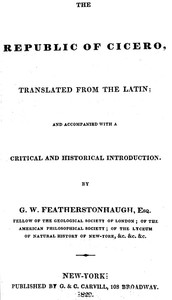
The republic of Cicero
Marcus Tullius Cicero
Letters of Marcus Tullius Cicero
Folio
Letters of Marcus Tullius Cicero
Marcus Tullius Cicero
Meditations
Folio
Meditations
Marcus Aurelius
The Enchiridion
Epictetus

Thus Spake Zarathustra
Friedrich Nietzsche
Beyond Good and Evil
Folio
Beyond Good and Evil
Friedrich Nietzsche