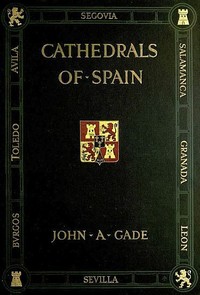
Cathedrals of Spain
free to read
length
71,351 words
a few pages a day
~8 min
finished in
38 days
full read
4h 57m
At Folio's default of ten pages a day, you finish Cathedrals of Spain in about 38 days — roughly 8 minutes of reading each morning.
The opening
the first pages of Cathedrals of Spain, free
Note: Project Gutenberg also has an HTML version of this file which includes the numerous original illustrations. See 31966-h.htm or 31966-h.zip: (https://www.gutenberg.org/cache/epub/31966/pg31966-images.html) or (https://www.gutenberg.org/files/31966/31966-h.zip)
Images of the original pages are available through Internet Archive. See http://www.archive.org/details/cathedralsofspai00gadeiala
CATHEDRALS OF SPAIN
[Illustration: Photo by J. Lacoste, Madrid
NEW CATHEDRAL]
[Illustration: SALAMANCA]
CATHEDRALS OF SPAIN
by
JOHN ALLYNE GADE
Fully Illustrated
[Illustration]
Boston and New York Houghton Mifflin Company The Riverside Press Cambridge 1911
Copyright, 1911, by John A. Gade All Rights Reserved
Published February 1911
TO THE LAST CHÂTELAINE OF FROGNER HOVEDGAARD
IN REVERENCE, GRATITUDE AND AFFECTION
PREFACE
In the last dozen years many English books on Spain have appeared. They have dealt with their subject from the point of view of the artist or the historian, the archæologist, the politician, or the mere sight-seer. The student of architecture, or the traveler, desiring a more intimate or serious knowledge of the great cathedrals, has had nothing to consult since Street published his remarkable book some forty years ago. There have been artistic impressions, as well as guide-book recitations, by the score. Some have been excellent, though few have surpassed the older ones of Dumas, père, and Gautier, or Baedeker's later guide-book. A year ago appeared the second and last volume of Señor Lamperez y Romea's "Historia de la Arquitectura Cristiana Española en la Edad Media," a work so comprehensive and scholarly that it practically stands alone.
It has seemed to me that certain buildings, and especially cathedrals, cannot be properly studied quite apart from what surrounds them, or from their past history. To look comprehendingly up at cathedral vaults and spires, one must also look beyond them at the city and the people and times that created them. In some such setting, the study of Avila, Salamanca the elder and the younger, Burgos, Toledo, Leon, Segovia,Seville, and Granada is here attempted, in the hope it will not prove too technical for the ordinary traveler, nor too superficial for the student of architecture. The cathedrals selected cover nearly all periods of Gothic art, as interpreted in Spain, as well as the earlier Romanesque and succeeding Renaissance, with which the Gothic was mingled. All the great churches were the work of different epochs and consequently contain several styles of architecture. The series here described is very incomplete, but the book would have grown too bulky had it included Santiago da Compostella with its heavenly portal, and Barcelona or Gerona, Lerida or Tudela.
Whether we read a page of Cervantes, or gaze on one of Velasquez's faces, or wander through one of the grand cathedrals of Spain, we realize that this great world-empire has never ceased to exist in matters of art, but still in the twentieth century must rouse our wonder and admiration. In barren deserts, on parched and lonely plains, amid hovels crumbling to decay, still stand the monuments of Spain's greatness. But if nowhere else in the world can one find such glorious works of art surrounded by such squalor, let us draw from the past the promise of a revival in Spain of all that constitutes the true greatness of a nation. In the fourth century, Bishop Hosius of Cordova was, from every point of view, the first living churchman--Cordova itself became, under the Ammeyad Caliphs in the tenth century, the most civilized, the most learned, and the loveliest capital in Europe. Three hundred years later, Alfonso X of Castile was not only a distinguished linguist and poet, but the greatest astronomer and lawgiver of his age. When the Spanish people have once more made education as general as it was under the accomplished Arabs, and adopted the division of power insisted on in a letter from Bishop Hosius to the Emperor Constantius, "Leave ecclesiastical affairs alone.... We are not allowed to rule the earth," they will take the rank their character and genius deserve among the nations. Their cathedrals will then stand in an environment befitting their grandeur, a society which will help them to transmit to coming generations the noblest, imperishable hopes of humanity.
Keep going from exactly here — Folio remembers your place and serves the next portion tomorrow.
continue reading Cathedrals of SpainAbout this free edition
Cathedrals of Spain by John A. Gade (1875-1955) is free to read in full. Folio serves it in daily portions you can actually finish, tracks your streak and reading position across devices, and reads every page aloud with a built-in narrator. The text comes from Project Gutenberg.
More like Cathedrals of Spain
The History of the Peloponnesian War
Folio
The History of the Peloponnesian War
Thucydides
The History of Herodotus
Folio
The History of Herodotus
Herodotus
The Gallic Wars
Folio
The Gallic Wars
Julius Caesar
Anabasis
Folio
Anabasis
Xenophon
The Lives of the Twelve Caesars
Folio
The Lives of the Twelve Caesars
Suetonius
Germania
Folio
Germania
Tacitus

The History of the Decline and Fall of the Roman Empire
Edward Gibbon
The Travels of Marco Polo
Marco Polo