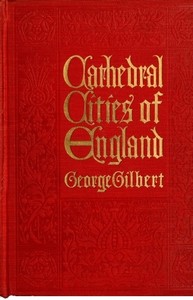
Cathedral Cities of England
free to read
length
60,959 words
a few pages a day
~8 min
finished in
33 days
full read
4h 14m
At Folio's default of ten pages a day, you finish Cathedral Cities of England in about 33 days — roughly 8 minutes of reading each morning.
The opening
the first pages of Cathedral Cities of England, free
In the following accounts of the Cathedral Cities of England, technical architectural terms will necessarily appear, and to the end that they should be comprehensive, I give here a slight sketch of the origin of the various forms, and the reasons for their naming, together with dates; and to the end that I may supply a glossary of easy reference, I place as side headings in this introduction the various expressions which will be met with throughout the book.
This, I hope, may relieve the reader of the tedium of having to turn to books of reference at each moment, and being subjected to a constant reiteration of the terms, which must necessarily be frequently employed.
The Cathedrals of England may be said to comprise illustrations of Anglo-Saxon, Gothic, and Norman, with their variations and combinations.
Constantine, A.D. 306-337.--Romanesque.--With the establishment of Christianity, more especially when recognised in Rome during the time of Constantine, arose the marvellous development of architecture, founded upon the basis of classical remains. This "Romanesque," as this period of architecture came to be called, permeated later the whole of Western Europe.
Basilica.--Relieved from immediate fear of persecution, the Christian architects straightway commenced to convert the "basilica" remains to suit the requirements of the "New Faith." The Basilica, as its derivation from the Greek Basilike ("the royal house") implies, "was the King's Bench" of the Romans. It was a long rectangular building, with sometimes rows of columns introduced to divide the space into a nave and aisles. One end terminated in an "apse," of semi-circular formation, where the judge and his assessors were accustomed to sit. This apse the Christians utilised as a chancel. The approach to the building was the "atrium," or forecourt, somewhat similar to the English Cathedral cloister, but differently situated.
A chief characteristic of the Roman buildings was the "round arch," mainly composed of brick or stone work. This the Romans for many years had used more in a decorative way than for utility, but which became of more structural significance in the hands of the Christians.
Romanesque.--Sixth to Twelfth Century.--In this wise, from the remains of the Basilica, with the further development of the "round arch" to the "semi-circular arch," the Christian Romans gradually evolved the style of architecture called "Romanesque," i.e., in the Roman Style. This style became prevalent throughout Western Europe from the beginning of the sixth to the close of the twelfth century. In process of time transepts were added and the choir prolonged, giving the outline, as it were, of a cross, the Holy Symbol of Christianity.
Anglo-Saxon.--500-1066.--Thus Romanesque may be said to be the fountain-head of Anglo-Saxon, Norman Proper, Anglo-Norman, and Gothic Architecture.
During the Roman occupation of England, missionaries came to her from Rome, the metropolis, and made converts, as they did in other countries, and as missionaries do nowadays in China and elsewhere. They and travelling merchants insensibly introduced the style of architecture then prevalent in Italy, namely, the Romanesque. Owing to the untutored nature of the Anglo-Saxons, their first attempts at imitating what would appear to them entirely new, together with the difficulty of procuring skilled labour, were necessarily crude.
Keep going from exactly here — Folio remembers your place and serves the next portion tomorrow.
continue reading Cathedral Cities of EnglandAbout this free edition
Cathedral Cities of England by George Gilbert is free to read in full. Folio serves it in daily portions you can actually finish, tracks your streak and reading position across devices, and reads every page aloud with a built-in narrator. The text comes from Project Gutenberg.
More like Cathedral Cities of England
The History of the Peloponnesian War
Folio
The History of the Peloponnesian War
Thucydides
The History of Herodotus
Folio
The History of Herodotus
Herodotus
The Gallic Wars
Folio
The Gallic Wars
Julius Caesar
Anabasis
Folio
Anabasis
Xenophon
The Lives of the Twelve Caesars
Folio
The Lives of the Twelve Caesars
Suetonius
Germania
Folio
Germania
Tacitus
The History of the Decline and Fall of the Roman Empire
Edward Gibbon
The Travels of Marco Polo
Marco Polo