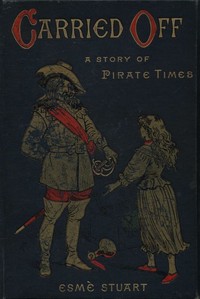
Carried Off: A Story of Pirate Times
first published 1888 · free to read
length
59,126 words
a few pages a day
~8 min
finished in
32 days
full read
4h 6m
At Folio's default of ten pages a day, you finish Carried Off: A Story of Pirate Times in about 32 days — roughly 8 minutes of reading each morning.
The opening
the first pages of Carried Off: A Story of Pirate Times, free
It was a beautiful warm spring evening, and as the sun sank slowly in the west it illuminated with quivering golden light the calm waters that surrounded green, marshy Canvey Island, which lies opposite South Benfleet, in the estuary of the Thames.
Harry Fenn had just come out of church, and, as was often his wont, he ran up a slight hill, and, shading his eyes, looked intently out towards Canvey and then yet more to his left, where Father Thames clasps hands with the ocean.
The eminence on which young fair-haired Harry stood was the site of a strong castle, built long ago by Haesten, the Danish rover, in which he stowed away Saxon spoil and Saxon prisoners, till King Alfred came down upon him, pulled down the rover's fortress, seized his wife and his two sons, and relieved the neighbourhood of this Danish scourge. How often, indeed, had the peaceful inhabitants trembled at the sight of the sea robber's narrow war-vessels creeping up the creek in search of plunder!
Harry, however, was not thinking of those ancient days; his whole soul and mind was in the present, in vague longings for action; full, too, of young inquisitiveness as to the future, especially his own future, so that he forgot why he had come to this spot, and did not even hear the approach of the Rev. Mr. Aylett, who, having been listening to a tale of distress from one of his parishioners at the end of the evening service, had now come to enjoy the view from Haesten's hill. As he walked slowly towards the immovable form of the boy, he could not help being struck by the lad's graceful outline; the lithe, yet strongly built figure, the well-balanced head, now thrown back as the eyes sought the distant horizon; whilst the curly fair locks appeared to have been dashed impatiently aside, and now were just slightly lifted by the evening breeze; for Harry Fenn held his cap in his hand as he folded his arms across his chest. He might have stood for the model of a young Apollo had any artist been by, but art and artists were unknown things in South Benfleet at that time.
Mr. Aylett shook his head as he walked towards the lad, even though a smile of pleasure parted his lips as he noted the comeliness of his young parishioner, whom he now addressed.
'Well, Harry, my boy, what may be the thoughts which are keeping you so unusually still?' Harry started and blushed like a girl, and yet his action was simple enough.
'Indeed, sir, I did not hear you. I--I came here to have a look at our cows down on the marsh. Father----'
Mr. Aylett laughed good-humouredly.
'Am I to believe that that earnest look is all on account of the cattle, Harry?' Harry felt at this moment as if he had told a lie, and had been found out by Mr. Aylett, who was so good and clever that he could almost, nay, sometimes did, tell one's thoughts.
'No, sir;' then, with a winning smile, the lad added, 'in truth I had forgotten all about the cattle. I was dreaming of----'
'Of the future, Harry. Listen, did not those same thoughts run thus? That it is dull work staying at home on the farm; that some of thy relations in past days had famous times in our civil wars, and went to battle and fought for the King, and that some even had been settlers in the old days of Queen Bess, and that, when all is said and done, it wants a great deal of self-denial to stay as thou art now doing, cheering the declining years of thy good father and mother. Some such thought I fancied I could read in your face, boy, when singing in the choir just now. Was it so? I would have you use candour with me.'
Harry turned his cap round and round slowly in his hands. Mr. Aylett was certainly a diviner of thoughts; but Harry was far too honest, and of too good principle, to deny the truth. It was his honesty, as well as his pluck and courage, that made him so dear to the clergyman, who had taught the boy a great deal more learning than usually fell to the lot of a yeoman's son in those days, even though Mr. Fenn farmed his own land, was well-to-do, and could, had he so willed, have sent his son to Oxford; but he himself had been reared on Pitsea Farm, had married there, and there he had watched his little ones carried to the grave, all but Harry. Yes, Harry was his all, his mother's darling, his father's pride; the parson was welcome to teach him his duty to his Church, his King and his country, and what more he liked, but no one must part the yeoman from his only child.
And Harry knew this, and yet often and often his soul was moved with that terribly strong desire for change and for a larger horizon, which, so long as the world lasts, will take possession of high-spirited boys. However, the lad was as good as he was brave; he knew that he must crush down his desire, or at least that he must not show it to his parents; but he did not try to resist the pleasure of indulging in thoughts of a larger life, thoughts which Mr. Aylett guessed very easily, but which would have made his father's hair stand on end. This evening Mr. Aylett's face looked so kind that Harry's boyish reserve gave way, and with rising colour he exclaimed:
Keep going from exactly here — Folio remembers your place and serves the next portion tomorrow.
continue reading Carried Off: A Story of Pirate TimesAbout this free edition
Carried Off: A Story of Pirate Times by Esmè Stuart (1851-1934) is free to read in full. Folio serves it in daily portions you can actually finish, tracks your streak and reading position across devices, and reads every page aloud with a built-in narrator. The text comes from Project Gutenberg.