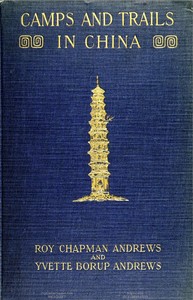
length
95,814 words
a few pages a day
~8 min
finished in
51 days
full read
6h 39m
At Folio's default of ten pages a day, you finish Camps and Trails in China in about 51 days — roughly 8 minutes of reading each morning.
The opening
the first pages of Camps and Trails in China, free
"Let us probe the silent places, let us seek what luck betide us; Let us journey to a lonely land I know. There's a whisper on the night-wind, there's a star agleam to guide us, And the Wild is calling, calling ... let us go."
--Service.
PREFACE
The object of this book is to present a popular narrative of the Asiatic Zoölogical Expedition of the American Museum of Natural History to China in 1916-17. Details of a purely scientific nature have been condensed, or eliminated, and emphasis has been placed upon our experiences with the strange natives and animals of a remote and little known region in the hope that the book will be interesting to the general reader.
The scientific reputation of the Expedition will rest upon the technical reports of its work which will be published in due course by the American Museum of Natural History. To these reports we would refer those readers who desire more complete information concerning the results of our researches. At the time the manuscript of this volume was sent to press the collections were still undergoing preparation and the study of the different groups had just begun.
Although the book has been largely written by the senior author, his collaborator has contributed six chapters marked with her initials; all the illustrations are from her photographs and continual use has been made of her daily journals; she has, moreover, materially assisted in reference work and in numerous other ways.
The information concerning the relationships and distribution of the native tribes of Yün-nan is largely drawn from the excellent reference work by Major H. R. Davies and we have followed his spelling of Chinese names.
Parts of the book have been published as separate articles in the American Museum Journal, Harper's Magazine, and Asia and to the editors of the above publications our acknowledgments are due.
That the Expedition obtained a very large and representative collection of small mammals is owing in a great measure to the efforts of Mr. Edmund Heller, our companion in the field. He worked tirelessly in the care and preservation of the specimens, and the fact that they reached New York in excellent condition is, in itself, the best testimony to the skill and thoroughness with which they were prepared.
Our Chinese interpreter, Wu Hung-tao, contributed largely to the success of the Expedition. His faithful and enthusiastic devotion to our interests and his tact and resourcefulness under trying circumstances won our lasting gratitude and affectionate regard.
The nineteen months during which we were in Asia are among the most memorable of our lives and we wish to express our deepest gratitude to the Trustees of the American Museum of Natural History, and especially to President Henry Fairfield Osborn, whose enthusiastic endorsement and loyal support made the Expedition possible. Director F. A. Lucas, Dr. J. A. Allen and Mr. George H. Sherwood were unfailing in furthering our interests, and to them we extend our hearty thanks.
To the following patrons, who by their generous contributions materially assisted in the financing of the Expedition, we wish to acknowledge our great personal indebtedness as well as that of the Museum; Mr. and Mrs. Charles L. Bernheimer, Mr. and Mrs. Sidney M. Colgate, Messrs. George Bowdoin, Lincoln Ellsworth, James B. Ford, Henry C. Frick, Childs Frick, and Mrs. Adrian Hoffman Joline.
Keep going from exactly here — Folio remembers your place and serves the next portion tomorrow.
continue reading Camps and Trails in ChinaAbout this free edition
Camps and Trails in China by Roy Chapman Andrews (1884-1960) is free to read in full. Folio serves it in daily portions you can actually finish, tracks your streak and reading position across devices, and reads every page aloud with a built-in narrator. The text comes from Project Gutenberg.
More like Camps and Trails in China
Whale Hunting with Gun and Camera
Roy Chapman Andrews
Treasure Island
Robert Louis Stevenson
Kidnapped
Robert Louis Stevenson
The Call of the Wild
Jack London
White Fang
Jack London
The Sea-Wolf
Jack London
The Count of Monte Cristo
Alexandre Dumas
The Three Musketeers
Folio
The Three Musketeers
Alexandre Dumas