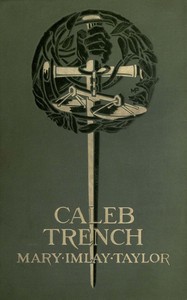
length
69,681 words
a few pages a day
~8 min
finished in
37 days
full read
4h 50m
At Folio's default of ten pages a day, you finish Caleb Trench in about 37 days — roughly 8 minutes of reading each morning.
The opening
the first pages of Caleb Trench, free
The negro disappeared, and Diana moved slowly to the table at the farther end of the long room, and stood there turning over some papers in her leisurely, graceful way.
“Who in the world is it now?” Mrs. Eaton asked, looking up from her solitaire, “a book agent?”
“Caleb Trench,” Diana replied carelessly, “the shopkeeper at Eshcol.”
“The storekeeper?” Mrs. Eaton looked as if Diana had said the chimney-sweep. “What in the world does he want of you, my dear?”
Diana laughed. “How should I know?” she retorted, with a slight scornful elevation of her brows; “we always pay cash there.”
“I wonder that you receive him in the drawing-room,” Mrs. Eaton remonstrated, shuffling her cards with delicate, much be-ringed fingers, and that indefinable manner which lingers with some old ladies, like their fine old lace and their ancestors, and is at once a definition and classification. Thus, one could see, at a glance, that Mrs. Eaton had been a belle before the war, for, as we all know, the atmosphere of belledom is as difficult to dissipate and forget as the poignant aroma of a moth-ball in an old fur coat, though neither of them may have served the purposes of preservation.
The girl made no reply, and the older woman was instinctively aware of her indifference to her opinions, uttered or unexpressed. There were times when Diana’s absorption of mood, her frank inattention, affected her worldly mentor as sharply as a slap in the face, yet, the next moment, she fell easily under the spell of her personality. Mrs. Eaton always felt that no one could look at her youthful relative without feeling that her soul must be as beautiful as her body, though she herself had never been able to form any estimate of that soul. Diana hid it with a reserve and a mental strength which folded it away as carefully as the calyx of a cactus guards the delicate bloom with its thorns. But the fact that Mrs. Eaton overlooked was still more apparent, the fact that a great many people never thought of Diana’s soul at all, being quite content to admire the long and exquisite curves of her tall figure, the poise of her graceful head, with the upward wave of its bright hair, and the level glance of her dear eyes under their thick dark lashes. There was something fine about her vitality, her freshness, the perfection of her dress and her bearing, which seemed so harmoniously accentuated by the subdued elegance of the charming old room. Nature had specialized her by the divine touch of a beauty that apparently proclaimed the possession of an equally beautiful spirit; not even the flesh and blood surface seemed always impenetrable, but rather delicately transparent to every spiritual variation, like the crystal sphere of the magician. But Mrs. Eaton, pondering on her young cousin’s personality from a more frivolous standpoint, took alarm most readily at her independence, and was overcome now with the impropriety of receiving a village shopkeeper in the drawing-room after dinner.
“My dear,” she remonstrated again, “hadn’t you better speak to him in the hall?”
Diana looked up from her paper, slightly bored. “In that case, Cousin Jinny, you couldn’t hear what he said,” she remarked composedly.
Mrs. Eaton reddened and put a three spot on her ace instead of a two. “I do not care to--” she began and paused, her utterance abruptly suspended by the shock of a new perception.
For, at that moment, Kingdom-Come announced Diana’s unbidden guest and Mrs. Eaton forgot what she was going to say, forgot her manners in fact, and gazed frankly at the big man who came slowly and awkwardly into the room. His appearance, indeed, had quite a singular effect upon her. She wondered vaguely if she could be impressed, or if it was only the result of the unexpected contact with the lower class? She was fond of speaking of the Third Estate; she had found the expression somewhere during her historical peckings, and appropriated it at once as a comprehensive phrase with an aristocratic flavor, though its true meaning proved a little elusive.
Keep going from exactly here — Folio remembers your place and serves the next portion tomorrow.
continue reading Caleb TrenchAbout this free edition
Caleb Trench by Mary Imlay Taylor (1878-1938) is free to read in full. Folio serves it in daily portions you can actually finish, tracks your streak and reading position across devices, and reads every page aloud with a built-in narrator. The text comes from Project Gutenberg.
More like Caleb Trench

My Lady Clancarty
Mary Imlay Taylor
Pride and Prejudice
Jane Austen
Sense and Sensibility
Jane Austen
Emma
Folio
Emma
Jane Austen
Persuasion
Folio
Persuasion
Jane Austen
Mansfield Park
Folio
Mansfield Park
Jane Austen
Jane Eyre
Charlotte Brontë
The Tenant of Wildfell Hall
Folio
The Tenant of Wildfell Hall
Anne Brontë